



Everyone wants to create content. That includes the AI founder I spoke to this week who was convinced that publishing a 10,000-word manifesto would change his fledgling company’s fortunes. On the other hand, most people will tell you that no one pays for content.
Hayashi Aki is proof they’re both half right. She's a Tokyo-based ex-journalist whom companies hire to get things out of their own CEOs: the good and the bad, the stuff ChatGPT can’t tell you.
She started her career at the Asahi Shimbun, Japan's second-largest paper by circulation, then worked at some of the most interesting media brands in Japan in recent years: the Huffington Post, Forbes Japan, and business app NewsPicks. (Some of you might remember NewsPicks because its parent company bought Quartz in 2018.) She now runs Brand Journalism, working with about 15 companies on PR strategy, media relations, and owned media.
Her view is that content is still king, which means my AI founder isn’t wrong to want his manifesto. He just might need more help getting there than he thinks.

Aki doesn’t mind being disliked. She asks CEOs hard questions to draw out the interesting stories that become content their employees want to read. A reporter’s job isn’t flattery.
AI makes turning conversation into copy easy, so writers’ roles are moving upstream. Aki says more of her clients now ask her for strategic advice. Since AI offers infinite plausible business options, she says they want a neutral, objective advisor to help them pick a direction.
Media is now about people rather than institutions. CEOs can now announce their own news on YouTube, which breaks down the traditional systems of news distribution. Outlets that only sell information will struggle; the ones that survive will think of themselves as content makers.


Tell me about your experience at the Asahi Shimbun. What did journalism teach you that you took into your future career?
I started as a regional reporter. I was on the social affairs side: crime, court cases, all sorts. But I wasn’t optimistic about the future of media, so in 2013, in my fifth year as a reporter, when the paper set up a new-business division and held an open call internally, I put my hand up.
In the new business department, I researched foreign media and was involved in a project called “Asahi Jibunshi” — a personal-history service where an Asahi reporter would interview an ordinary person, and we would edit it into a book. The bespoke edition cost over a million yen, and we took orders from a great many customers.
Then I was told to come back to reporting for a while, and became a reporter on the economics desk, covering Japanese electronics companies, including Toshiba.
Looking back, what I was writing then wasn’t really true. Every single day I was writing pieces that passed judgment on the management failures of big companies — and yet, in the same position, I might well have made the same call. I felt I had no right to write those stories when I had never run a business myself.
Then you moved to the Huffington Post — did you get your taste of business there?
Huffington Post Japan was in its fifth year, and its survival was in question; there was a real anxiety that we had to get into the black that year. I ran the advertising business, built around sponsored content; I went out and sold, reported, and wrote the branded articles myself. In brand journalism, the New York Times’ T Brand Studio was one of my benchmarks.
We turned a profit within a year, but in the end I fell out with the newsroom. The better the branded business did, the more advertising articles there were, and I could feel the newsroom pushing back, saying that the journalism was being “dirtied.” And I pushed back against their pushback. Looking back, I was immature.
That was exactly when Forbes Japan tapped me on the shoulder, and I took on growing BrandVoice, Forbes’ native advertising and content platform, and the web editorial team.
What did Forbes Japan do differently in terms of sponsored content?
Forbes Japan flies the flag of positive journalism, and it has decided what it will not do: no scandal stories, no kicking a company when it’s down over its losses. Some business magazines sell on headlines built to provoke: “plunge into the red,” “downfall.” There are all sorts of views on how economic journalism should be done, but respect for business is fundamental to me, so I felt very much at home there.
A positive approach also means the magazine and the site fill up with forward-looking content, and business leaders come to see it as a title they want to appear in, which makes life much easier on the commercial side. The other distinctive thing about Forbes was projects like “30 UNDER 30 JAPAN,” which picks 30 people under 30 who will lead the next generation in Japan, and the entrepreneur rankings: editorial and the business side would launch them together, then tie advertising packages to them and make them into something interesting. It was exciting.
And then NewsPicks came calling…
NewsPicks approached me, and when I found out they were launching NewsPicks for Business, for corporate clients, I was intrigued — it was a completely different media business from advertising — so I moved. You sell to a company: if it has 10,000 employees, all 10,000 get it, and you take on the whole thing, from the internal newsletter to talent-development content, building it together with the client and pitching it to people inside a large corporation.
For example, if you worked at Company A, inside the NewsPicks app there would be a tab only Company A employees could see, with internal news coming through and curation done for the inside audience. I ended up knowing internal information about big companies that NewsPicks’ own reporters didn’t know. By the end, the NewsPicks for Business editorial team had swelled to about 30 people, and we launched a print magazine aimed at in-house innovators.
Why would a CEO talk to you rather than to someone inside the company? Didn’t you find that hard?
Say a CEO is putting out his New Year’s message internally through NewsPicks. If someone inside writes it up, a certain amount of deference creeps in, or it just becomes something that sounds nice. But if an outsider reports it, you get last year’s failures, the pain, their own regrets. Really deep material. I ask a lot of questions people would rather not be asked. But often you don’t get an essential answer unless you ask the unpleasant thing. I don’t mind being disliked. The result is a message that actually reaches employees.
Reporting also isn’t just assembling what someone said. It’s the things they didn’t say: what they wanted to express but couldn’t put into words, the surrounding context, the moments where the CEO says yes but inwardly means no. Putting all of that into language that anyone can understand is the reporter’s job. If you build a piece only out of what was said, it’s paper-thin. But if you read what’s underneath and write it up, it becomes a translation: this is what I was trying to say. That’s what people are most pleased by. And I came to think that’s an enormously important thing in running an organization, in management.
“Reporting also isn’t just assembling what someone said. It’s the things they didn’t say: what they wanted to express but couldn’t put into words, the surrounding context, the moments where the CEO says yes but inwardly means no.”
How has it been since going independent?
There’s a woman I’m close to who lives in the building next door. She was a snowboarder, then a first-class cabin attendant at JAL, then went independent. When I was leaving NewsPicks, she said to me: “Aki, from now on you’re only allowed to do the things you want to do.” Until then I’d only been thinking about what I “should” do: that to achieve something I had to do this, and I had to do that, and the things I wanted to do could wait.
Building a company and scaling it takes enormous energy — managing people, raising money. I don’t really want to do that anymore. The happiest I ever am is sitting alone writing with music on.
What are you doing now?
I’m working with about 15 companies at the moment: PR strategy for some, media relations for others, helping some launch owned media, and sometimes making the content for that owned media itself — newsletters, CEO messages. Editorial in service of business and management.
How do you use AI in your process?
I record the audio and transcribe it — exactly what we’re doing here — and then I give the transcript direction. This is the purpose, this is the kind of piece, roughly this headline, this feel; a straight Q&A, or narrative prose with quotes. Fact-based, obviously, is the premise. Specify all that and what comes back is a reasonably solid draft with very little hallucination. Then I polish it and breathe soul into it by hand.
That’s much the same as me when I’m writing up an interview like this. I put the recording into Claude and ask it to tidy it up, and then do the editing afterwards to get the flow correct and make it the right length, and make sure the speaker’s intentions are punchy and clear.
Of course, there’s a lot I can’t put into AI because I have to protect client information, so I’m strict about governance there. But using AI has taken me from maybe one piece a night to 10. Turning what you’ve reported into a serviceable draft is a solved problem. Clients themselves will be able to do that before long, so what will be asked of me from here is the more upstream work — everything before the writing, and drawing the story out of the person — plus the desk-editing on the copy and the risk management.
In fact, business leaders are asking me about strategy more and more. Will you help us think of a name for the new service? Could you start with the website? It often begins with helping on a press release, but as you write, you arrive at the point where the value of the product has to be much clearer, or there’s no news value in it.
I do feel that even when I’ve done media relations or content work for clients, they have come to trust me enough that they also ask for strategic advice, similar to what you’re saying.
It’s about trust. AI hands you infinite options: plausible-sounding phrases, plausible-sounding copy, piles of it. But in the end, a human has to make the call. Do we put 10 million yen into this or not? Do we go with this word or that one, this name? Website or brochure? In the end, a person decides.
“AI hands you infinite options: plausible-sounding phrases, plausible-sounding copy, piles of it. But in the end, a human has to make the call.”
Quite a few people are anxious about that final call. What they want is an objective stamp of approval. I’ve been a reporter all along, so that’s the role people ask of me. A reporter’s eye is the reader’s eye — you can’t help thinking about the person on the receiving end, ordinary people, and how they’ll take it. Will this be ignored when it goes out? Will people dislike it? Or will it land warmly?
If you went in-house at a company, do you think you might lose the objectivity your clients value?
If you become one with the company, if it becomes your own concern, objectivity fades. Our site, my business card, our brand are all completely black — like a judge’s black robes, meaning we can’t be stained the color of anyone.
A lot of your work revolves around asking questions. You sit down with CEOs and draw things out of them to create content that their employees or other people want to read. How do you ask good questions?
I want to stand in the other person’s shoes and use my imagination as far as I possibly can, because unless someone believes you really understand, they won’t talk to you. That’s why I left the newspaper and why I started a company — you can’t know how a manager feels without running something yourself, however small. The difficulty of keeping a company going, how brutal the end of the quarter is: I don’t want to know that as information, I want to know it as sensation, in my body.
I also use the phrase “by the way” (ちなみに) a great deal. “By the way, what did you do this weekend?” “By the way, what did it feel like when those brutal results came out?” And they think, “This one’s at least trying to understand” — and something honest slips out.
Of everything you’ve reported, what has stayed with you most?
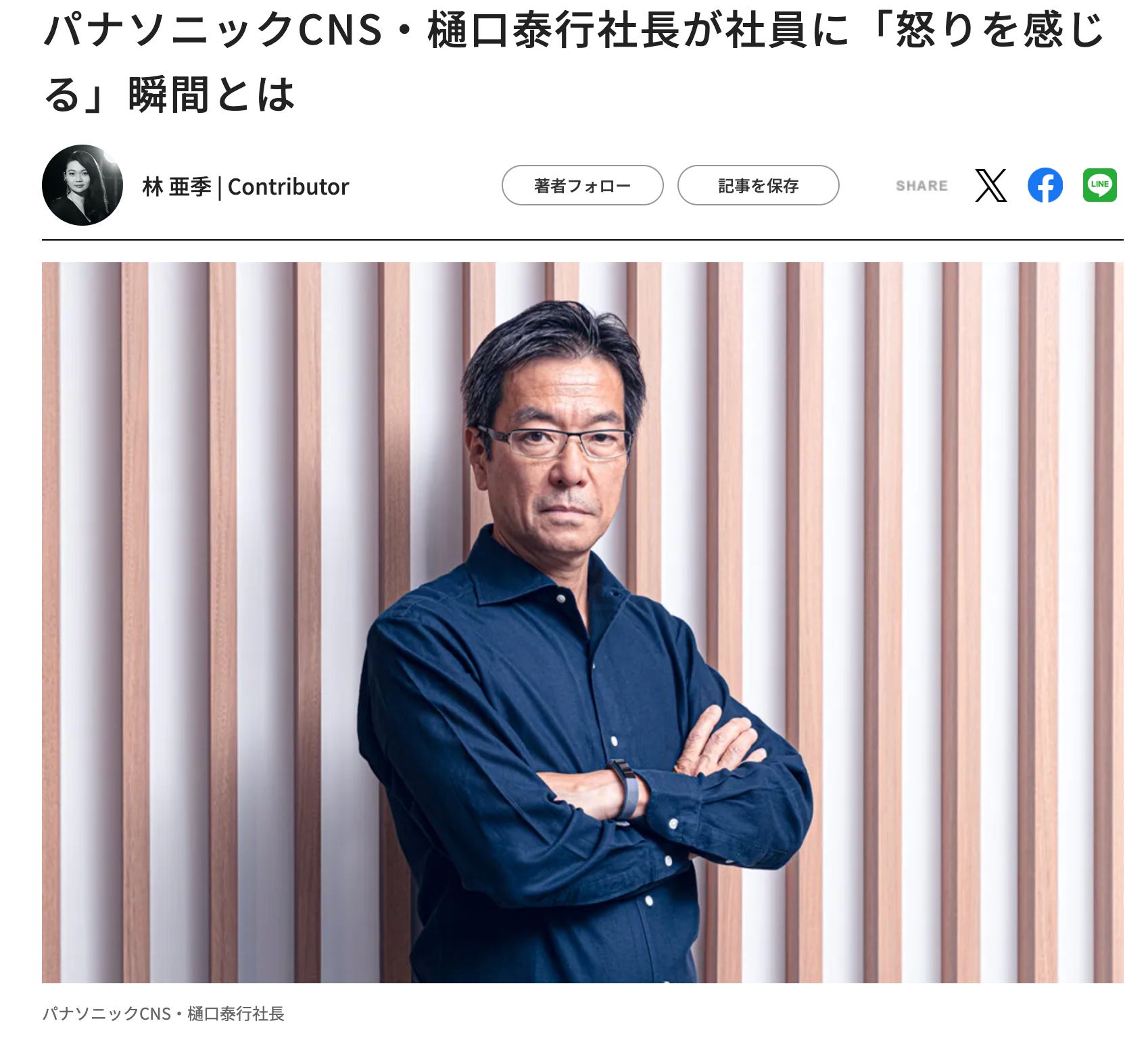
Panasonic used to have a B2B arm called CNS, now called Panasonic Connect. I got to interview its president, Higuchi Yasuyuki, who had previously been president and chairman of Microsoft Japan, for Forbes.
I asked him what makes him angry, and the piece was read enormously widely. What makes him furious is behavior that lacks respect — a compliance breach, or treating a customer as though they don’t matter. And appointments where you think, why is this person in this position? — because the organization then heads off in a strange direction. But replace them decisively, and the staff’s reaction tells you it was the right call. It’s painful, but what matters is imagining how things feel to employees at gut level.
What Higuchi was really talking about, in the end, was sensitivity. To change an organization, your executives have to be sensitive enough to feel it. “Tone at the top” — you create the tone from the top down.
What’s your outlook for media?
Content is king, still. The value of a new format, or of content that scratches at people’s hearts, doesn’t change. If anything it goes up, precisely because there is so much information around.
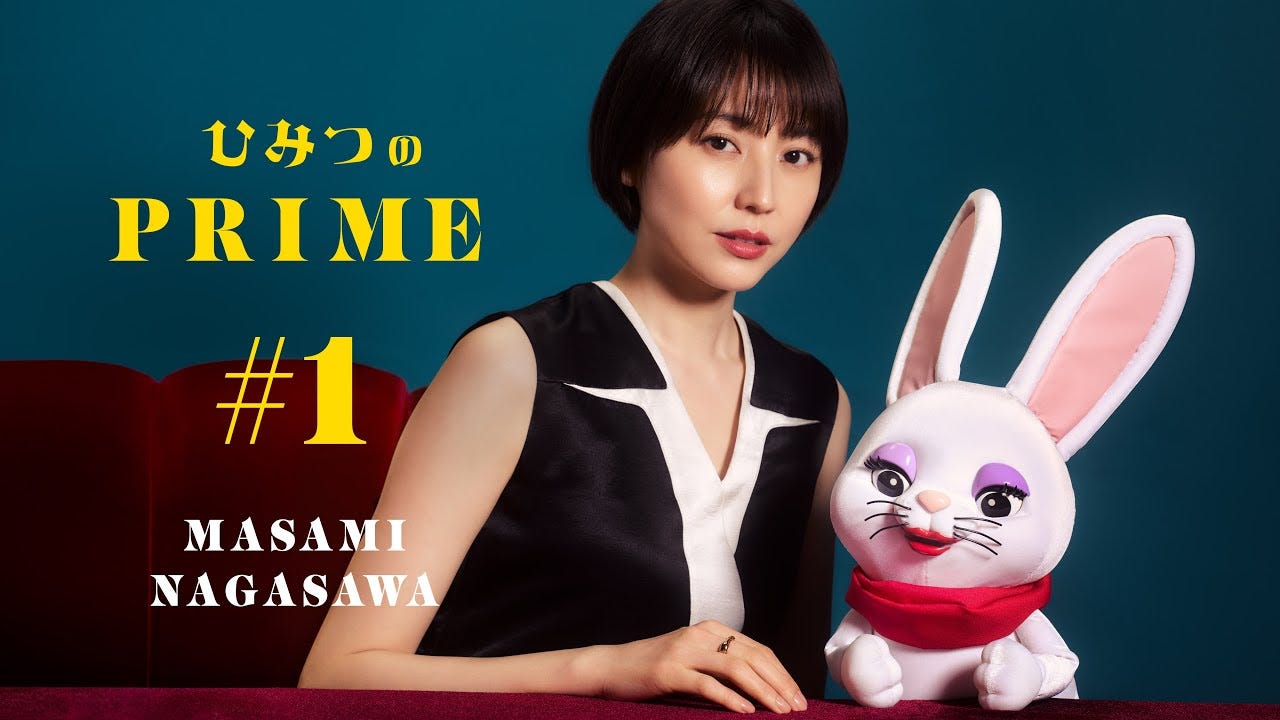
Take THE FIRST TAKE, the YouTube show that films artists singing in a single take against a white background with one microphone — it became hugely popular. You can see them being nervous. The producer who made it also made “Himitsu no PRIME,” the show that plays in taxis where a rabbit puppet interviews well-known people, and I got to interview him. It made me think there are still plenty of content formats out there that nobody has seen yet.
There’s a fascinating company I’m handling PR for at the moment whose CEO is a huge influencer — hundreds of thousands of followers, and a lot of fans on YouTube. He simply announces it all first himself: “I’ve started this project with this person,” “We’ll ship within six months.” With a CEO like that, even a dedicated beat reporter can’t keep up. It’s already out on YouTube, and his followers outnumber the outlet’s readers, so it reaches people before any outlet can report it.
Media is becoming about people rather than organizations. Which means the systems that news distribution rests on — the press clubs, the press releases — are breaking down and being remade. Outlets that are only selling information are going to struggle. The ones that survive will be the ones that think of themselves as content makers, and that think now is their chance.
“Outlets that are only selling information are going to struggle. The ones that survive will be the ones that think of themselves as content makers, and that think now is their chance.”

Thank you for reading this week! For those of you based in London, I’m co-hosting an event with Alys Key about collaboration in writing, featuring some of my newsletter guests. Join us for some IRL fun on August 20th.