



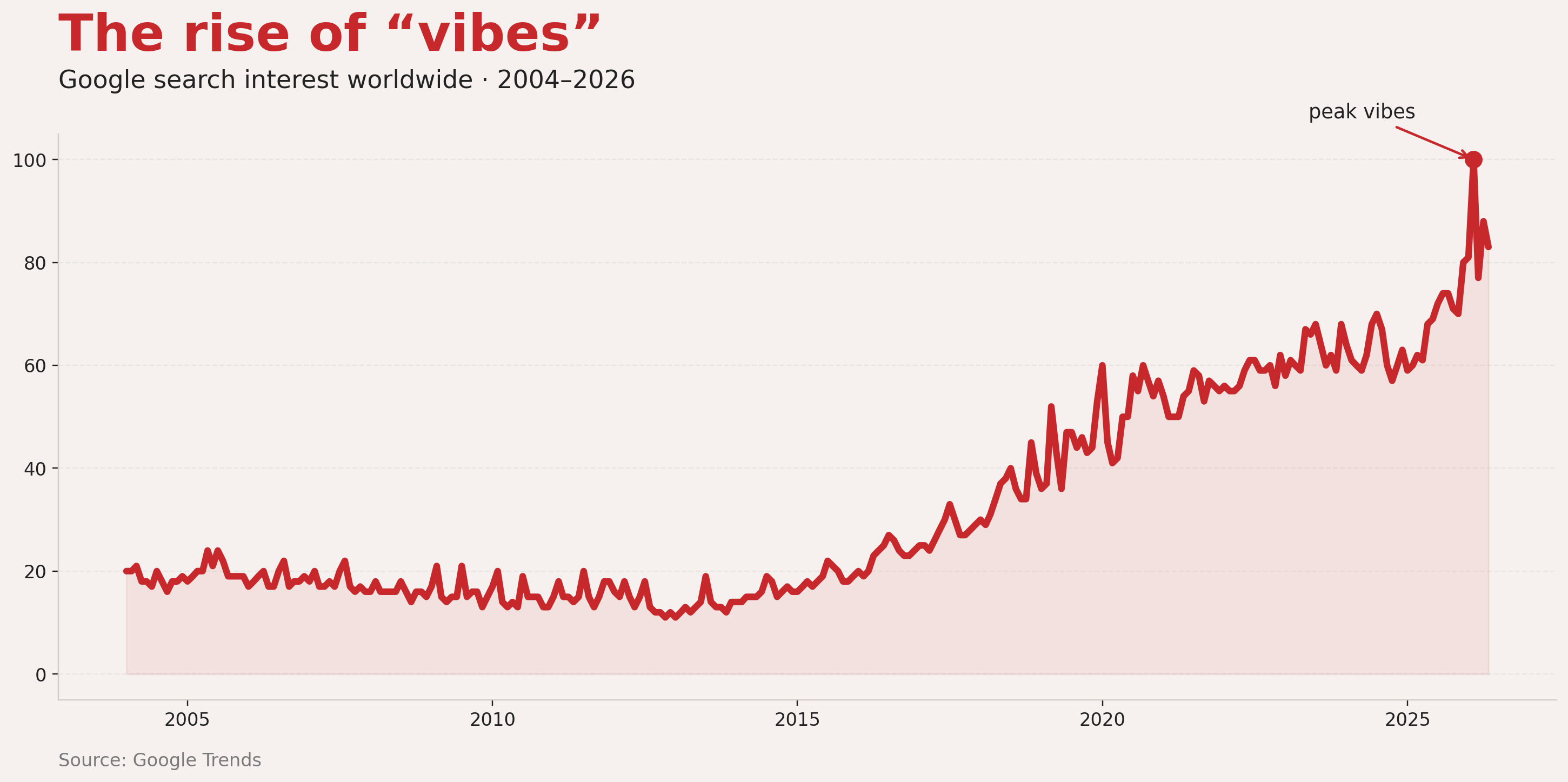
If we are to believe Google, the vibes really got going around 2015.
In the middle of the last decade, the ’v word’ came to mean more than a physical place or the specific energy of a person. It became a diffuse atmosphere — summer vibes — or something performed — hot girl summer vibes. Now, we’ve even allowed this ephemerality to replace hard-coded foundations. With AI-powered vibe coding, technical novices don’t even need code to create their own apps.
Vibes float in the air like a virus or a perfume — impossible to avoid. The LinkedIn feed. The collection of bestselling books on display at the bookstore. When something we’ve never wanted sparks FOMO in us, as my investor friend confided to me:
“We hear investor A or investor B is considering a deal, and though nothing about the company in question has changed, suddenly we think, ‘Maybe we should take a look…’”
Vibes reveal the consensus, but they also cause us to see credibility where there is no proof — an investment that might be better to skip. They cause us to see a trend when there is no line.
I’ve worked in tech and VC, where the vibes seem to be permanently stuck on 11, partially because the manipulation of perception is the only way you raise capital.
This is also why I’ve always been skeptical of vibes. Instead of being swayed by what’s outside, I’ve been trying to trust what’s inside: my own emotions. Spending time training and giving weight to my emotional responses helps me be a better writer, editor, and thinker. Because good writing trusts its gut.
Enjoyment and tradwriting
Emotions can be immediate and specific. That’s why they are such a good litmus test of the diffuse and approximate nature of vibes. Envy at someone else’s accomplishment. Anxiety about the future of my industry. Frustration when there’s no customer service number to call. What are all these telling us?
The emotion I’ve been trying hardest to listen to lately is enjoyment — because in an era when everyone is competing for attention and survival, enjoyment is the first thing we sacrifice.
I was using my second boyfriend Claude frequently for editing help—Is the thesis of the piece clear? How can I tighten this paragraph? But I was finding that I didn’t even remember what I edited. I had a vague sense of always being pressed for time, and felt none of the satisfaction that comes with a job well done.
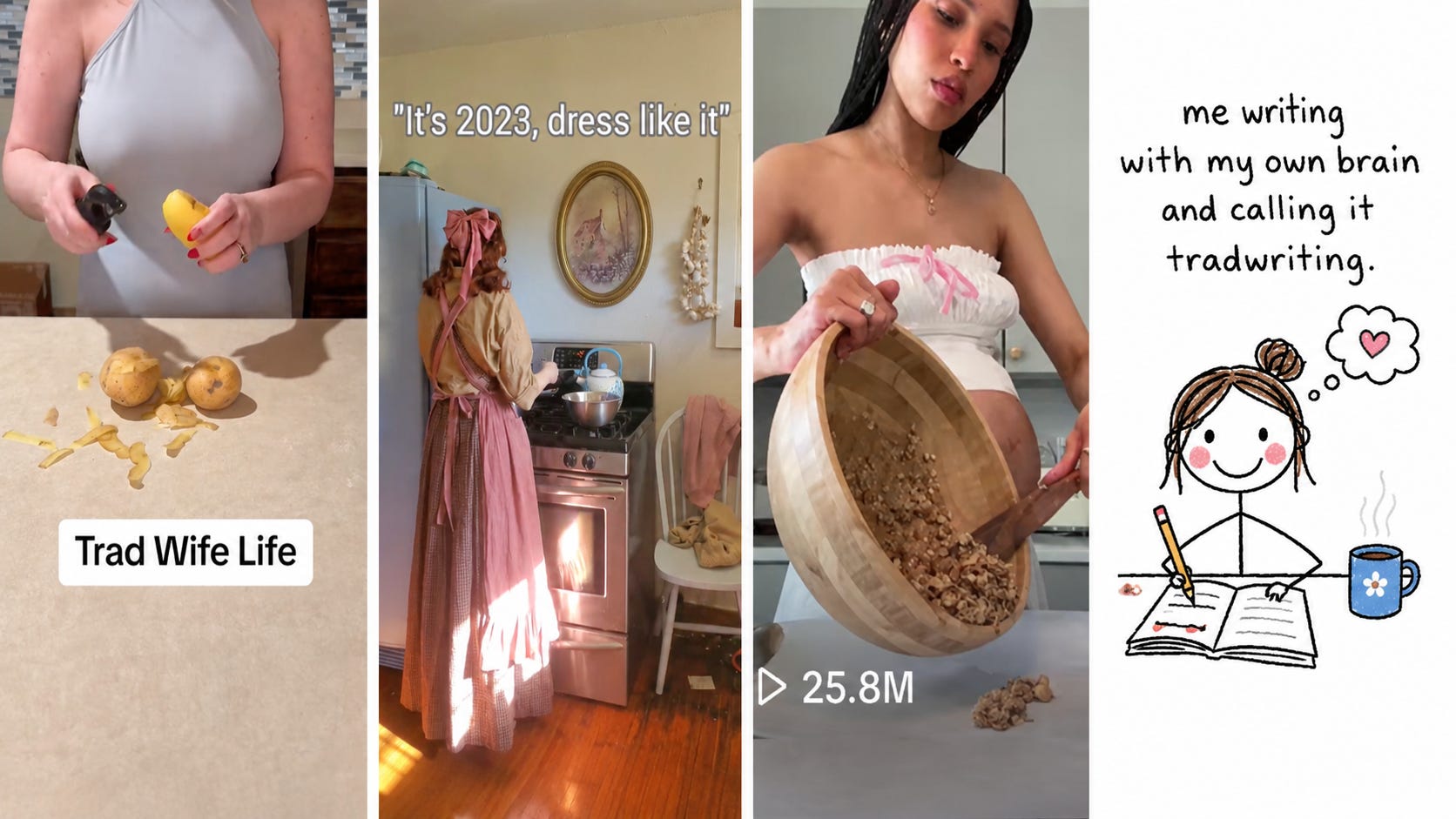
So I’ve returned to what I call “tradwriting.” Like flipping a switch, enjoyment returned.
I find pleasure when I untangle someone’s mangled prose, or suggest the perfect kicker to an opinion piece, all mined from my own brain. Which, on a good day, gives me much quicker results to these kinds of writing puzzles than AI.
I am in a privileged position to be able to focus on enjoyment in my career. That is why I guard it even more closely.
Enjoyment is also a clue about where we're headed because of what it says about human motivation. I don’t enjoy the kind of tinkering that a lot of the more advanced AI tools currently require to work. So to anyone who tries to convince me again why every yoga studio and independent bakery owner will vibe code their own inventory analysis tool, bringing an AI revolution to small businesses, I respond: “No, because that’s not what they enjoy. They enjoy teaching movement. Or making a great croissant.”
A small anti-vibes guide
I have a handful of principles that I use to stay honest with my gut when the vibes are pointing my brain in many different directions. Good writing and good work come from that honesty.
Trust your emotional response to the world around you and to what you’re making. If something moves you, that’s a signal. If something bores you, that’s also a signal. And if your own writing bores you, it’s not good enough yet. That’s the hardest one to admit, which is why I’ve gotten so much from working with a writing coach and enrolling in a fiction-writing course. They hold me accountable for going the extra 10%.
Be wary of opinions, including your own, that contradict how something made you feel. Don’t let vibes overwrite your gut. This is a twist on some sound advice from the jazz critic and music historian Ted Gioia. He writes, “You can feel your response to music…long before you formulate an analytical or verbal interpretation of it. This is the ultimate aesthetic reality…Nobody falls in love with anything because of a reason.”
Get bored on purpose. Vibes sneak in when you’re trying to fill all your empty time with input. Boredom is a chance for your mind to clear itself and new ideas to emerge. (There is even research that boredom makes us more creative.)
Like what you like. It doesn’t have to be cool. Some of the best writers in the world are writing about deeply unfashionable things with total conviction, and that conviction is what makes them a pleasure to read. The most interesting conversations don’t happen on the bandwagon.
When you can’t tell whether you really care about something or just feel like you should, write something else. The thing you’re avoiding is usually the thing worth writing. This week, I started writing an essay that I thought sounded smart but I kept coming back to this idea of emotions. That’s what I needed to write.
The vibes are telling you what to feel. Listen to what your gut tells you. Then create great things.
Thank you for reading! I’ll be off for a few weeks as I travel to a land-locked central Asian country. If you missed it and want to read more of my writing, I published a piece this week in Every on why humans are still better at asking good questions than AI and how good questions can surface the best stories. It includes my second favorite Werner Herzog story after that time he got shot on camera and brushed it off (“It’s not significant.”).
as you can probably guess, i was strongly nodding through this whole thing. someone recently told me that human irrationality is a feature, not a bug… and i think that the lens of enjoyment and your anti-vibes list really brings needed layers to that 'irrationality.'
p.s. i absolutely love your coinage of tradwriting!
This is kinda maybe related, but your piece made me think of it so I’m sharing anyway. Been working with my 10yo on her writing and how AI might fit in. What’s interesting to me is most writing education for kids is very focused on sounding like someone else and that seems so counterproductive. We’ve set rule that she can use AI to help research facts for her stories (she’s mostly writing fiction) but I want her focused on figuring out how she likes to write and what she uniquely sounds like. My general theory with this stuff is AI is just a mirror on society and much of the pushback is actually much more deeply rooted in failures of education and prioritization.