



✨ If you are in London on July 6th, join me for an event on writing hot takes.
As more journalists get axed or jump ship for six-figure “chief storyteller” jobs, I’m telling more companies to focus on their own content (“owned media”) instead of hitting their heads against the wall trying to land traditional coverage (“earned media”). AI has strengthened my argument; one recent audit found that 60% of materials cited in LLMs come from owned media.
But hold up. When was the last time you shared an article published by a company? If content boosts shareholder value, can it be cool?
Paul Abrahams might have the answer. He previously spent 15 years at the Financial Times and is now chief communications officer at Europe’s largest media group, RELX, where he built a content engine before AI made it cool. A FTSE-100 company, RELX rarely makes the headlines (largely by design), but you’re probably familiar with some of its subsidiaries, like data analytics company LexisNexis and academic publisher Elsevier.
Paul shared the team’s process, the tech tools they love, and what he’s stolen from Netflix and Hollywood on the way.

Process is the difference between content that dies in approvals and content that sees the light of day. RELX publishes 70 stories a year as a huge company because the team has a tight workflow, the right tech, and good writers. Showing reviewers a live story instead of a Word doc speeds up sign-off. And there is always just one final approver.
Owned content is about internal comms, too. Paul’s team used employee surveys to identify low-scoring areas, then created storytelling campaigns around those topics, driving employee engagement +21 points, advocacy +22, eNPS up 42%.
AI is a co-pilot for comms teams now. LLMs built employee personas from 20,000 verbatim survey comments and helped draft pitches for journalists. Tools like Second Nature help media-train execs with green/amber/red scoring.

Tell me about RELX. Many of my readers might not know it.
We’re the UK’s largest TMT group by quite a margin and the largest quoted media group in Europe, but I joke that my job is to make sure that nobody’s ever heard of RELX.
Despite wanting to make sure no one has heard of you, you run a big owned content operation. How did you get the inspiration for the kind of content that you are running now?
About eight years ago, I was reading a story on the BBC website about Swedish serial killers. Elements came in and out as you scrolled through; it felt immersive. At the bottom, it said, “Powered by Shorthand.”
I thought we could use Shorthand’s immersive, no-code storytelling tech in a corporate setting. The first story we did got three times more reads than we normally got with our own media. The second story got 17 times.
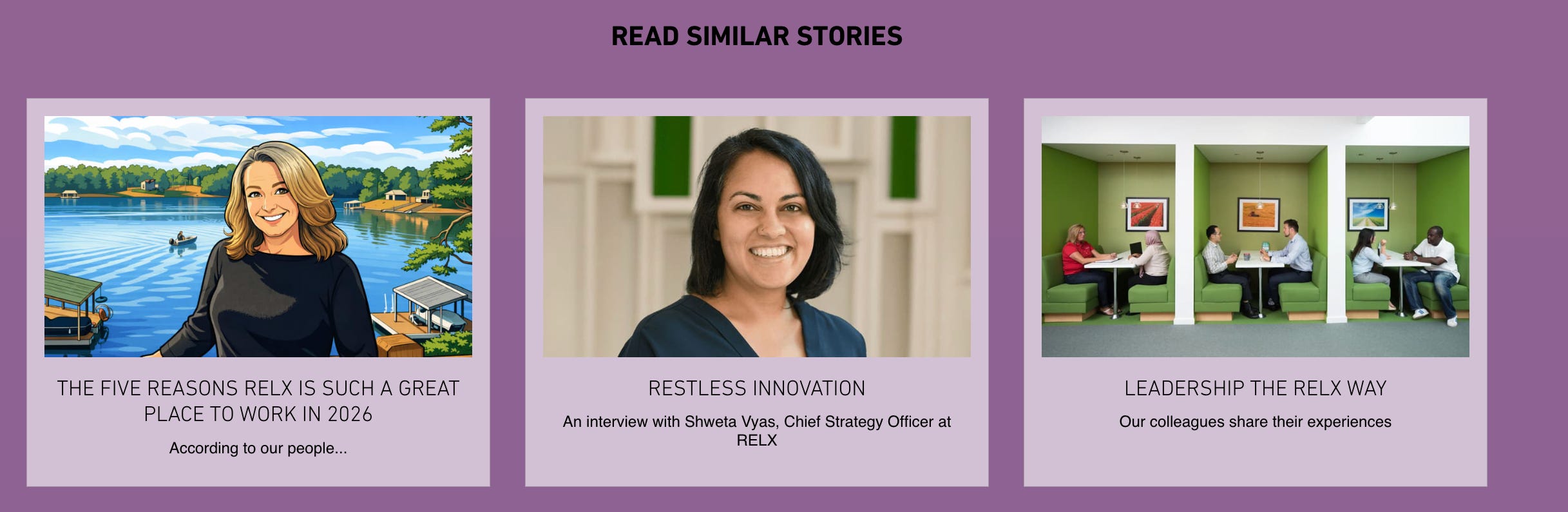
We had our first story in 2018. Last year, we did 70, and we got about 1.1 million reads, meaning people who have looked at the story. We can also measure how far down the story they get. We have links at the bottom — “If you like this story, you might like these” — and about 10% of our traffic is collected through that.
What kind of content are you writing?
The stories fall into two buckets: some are aimed at our employees and potential employees, and some are about the business itself. We use first-rate writers, and the idea is to produce pieces of journalism that people want to read.
How do you get 70 stories through in a year? I’ve worked with organizations where everyone has to weigh in on each piece, and it slows things to a crawl.
Somebody told me a large European corporate spent over a million euros on an owned-media strategy, and because so many people had inputted into the content, the outcome was unpalatable, and the project died. So the process is really important. A bit dull, but that’s what gets 70 stories through.
“Somebody told me a large European corporate spent over a million euros on an owned-media strategy, and because so many people had inputted into the content, the outcome was unpalatable, and the project died. So the process is really important.”
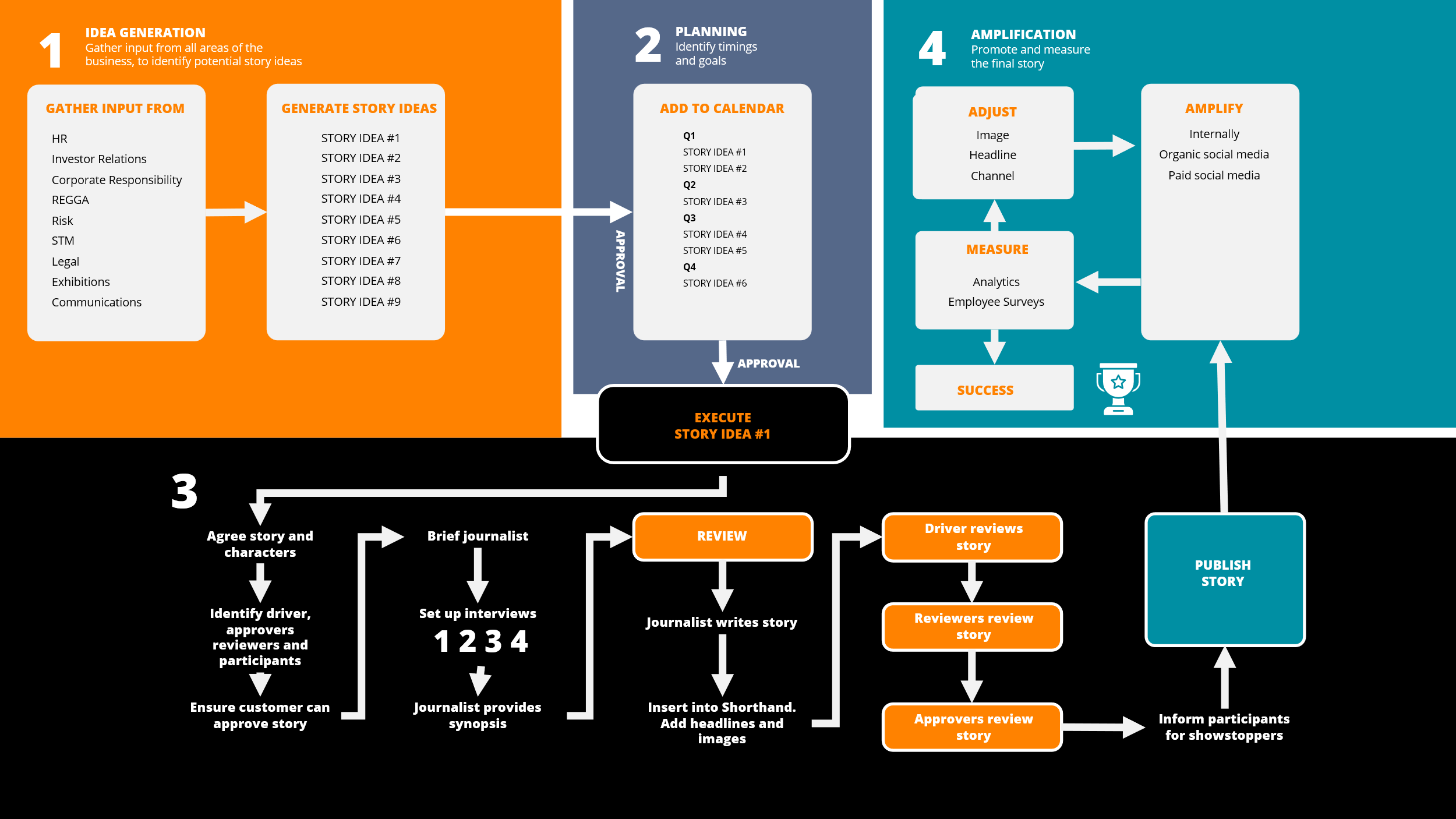
Around October, we ask every business and department what their priorities are and what stories they’d like next year. We build a quarterly calendar, and for each story we agree on the voices — no more than three or four: someone from the business, some customers. We pay above the industry average for writers because good writers come back, and very often we don’t have to edit the copy at all.
We brief the writer, set up the interviews, and let them run on their own. They send a synopsis first — a check-in to make sure they’re not heading the wrong way. Then we build it in Shorthand and show reviewers the live story, not a Word document, and ask, “Are there any showstoppers?” Because it’s not a Word doc, it’s much harder for them to start rewriting. There’s just one final approver.
Whenever you want sign-off on something, it’s always better to ask “Is there anything wrong” instead of “Review this entire document.”
Each of these steps is a hard lesson, where something’s gone wrong, and we had to insert something into the process.
Then we publish the story, amplify it through social media, and then we measure and adjust.
Interesting that social media is such a big channel for you.
Don’t underinvest in social media. In the beginning, everyone in the team was responsible for posting on a different social platform— somebody did Facebook, somebody did LinkedIn — and eventually we hired somebody as a social media manager. At one point, Twitter was incredibly effective. One could say it’s a dangerous environment for corporates, but it was very cheap, and we were able to target people who read specific publications. We would get 20,000 reads. An average FT story gets about 10,000 reads.
After the change of ownership at Twitter, they stopped taking our money, so we pivoted to LinkedIn. It’s a slower burn, but it still works.
How do you monitor the performance of stories?
We monitor each story. If a story performs well, we might double down on promotion; if not, we adjust the headlines and imagery. We were inspired by what Netflix was doing.
You mean like their dynamic titles?
You look at each tile for about three seconds, and after a minute, if you haven’t clicked, you go off to Amazon Prime. One of the things they found is that having a single person in the image — preferably famous, but we’re not Netflix — people are much more likely to click.
Do you have to use AI images, or do you use illustrators?
We use Midjourney.
That’s what we use at my company, Every, and we have really cool images. Tell me about some of the content you do on internal topics. How do you keep those engaging?
We have company-wide employee opinion surveys every three years, and smaller surveys every year. James Weekly, our head of internal comms, came up with an approach where we identify the areas the company had scored low in — that could be by specific job, or by geography, or on a particular topic like work-life balance — and then put storytelling campaigns together around those particular areas to try and get the scores up. We identify the managers who had scored highest on those particular topics, then go off and interview them.
So we were able to ask the people who were scoring highest on, say, what to do about your team’s work-life balance for their best practices. We’ve featured over 3,000 people over the eight years, up and down the organization — people we would never have known.
What is the process for creating those stories?
James has taken, I think, around 20,000 verbatim comments, which were sitting in a spreadsheet. We ran them through an LLM and created five personas. Then we run the content against the personas and ask if it lands.
The results over the past eight years have been amazing. Employee engagement is up 21 points, advocacy is up 22 points, our employee Net Promoter Score is up 42%, and referrals — when we hire people who’ve been referred — have also risen.
How has the owned content game changed since you started? I feel like many companies are leaning more into it because it’s hard to land coverage in traditional media.
The irony is that the owned-media strategy — because the LLMs are picking up owned media so much — kind of lucked out. When we first started eight years ago, we had no idea. It was in response to the problem that we couldn’t get anyone to write about us.
“The irony is that the owned-media strategy — because the LLMs are picking up owned media so much — kind of lucked out. When we first started eight years ago, we had no idea. It was in response to the problem that we couldn’t get anyone to write about us.”
I think there’s a geographical difference. In the US, owned has become very important, and you see some amazing salaries being offered for content. In the UK, the heads of comms and corporate affairs directors are generally five years behind.
A lot of it comes down to the fact that CEOs have differing desires to be high- or low-profile, and they have different stakeholder groups they’re trying to reach. If you’re Marks & Spencer and you’ve got a cybersecurity incident, you’re going to be in a very different position than us. If you’re British Gas or Centrica, big CEO interviews in the Times or the Financial Times become important. Our CEO has not done an on-the-record interview in 15 years, and never will. That just isn’t an option in a B2C company.
A lot of comms directors are still very focused on media and often have CEOs who love to be famous, but I caution whether that is always the right strategy.
Owned content is not expensive. We pay journalists for about 25 stories every year and then pay the Shorthand license. In nominal terms, my budget is the same as it was 14 years ago when I joined the company. So we had to be clever about how we allocate our capital.
“Our CEO has not done an on-the-record interview in 15 years, and never will.”
Have you used AI for the other parts of your comms job?
We have a storytelling system using Hollywood screenwriting techniques — there are 10 elements, including the hero, the inciting incident, the call to action, the dreadful alternative, the series of hurdles, the transformation. We used that to architect a story about LexisNexis Legal, and how they pivoted in six months with ChatGPT to getting a product out. We then took those 10 elements and asked four LLMs to write a 1,000-word story. Three of them were not bad.
And the fourth one?
Claude just hallucinated quotes and characters.
Sad!
We took those stories and asked the AI to turn them into a pitch for this particular journalist. It got 95% there, and then we were able to personalize it because we’d met the journalist before.
Then we took that messaging and created a briefing document for the person who was going to do the interview.
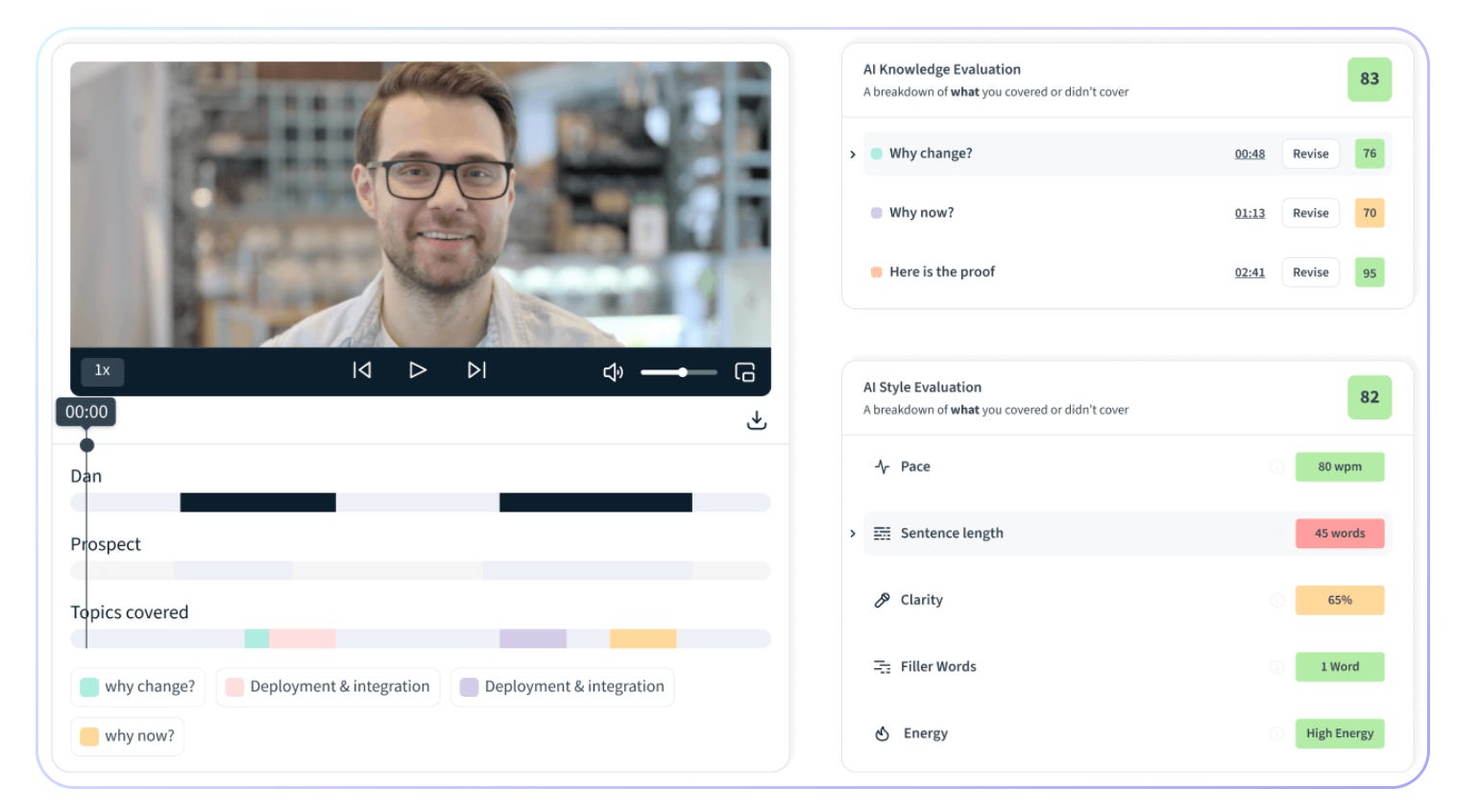
There’s a pitching tool called Second Nature that is perfect for media training. As you speak, it shows green, amber, or red based on whether or not the answers are too long or too short, whether or not the message is being delivered, if there is too much jargon...One of the more stressful parts of our job is telling people who’ve just signed big bonuses that they’re not brilliant at public speaking. Now you can just show them the output, and say, “You scored 68, and you need to get to 80, and here’s what we need to do to adjust.”
This is very cool.
Then you can record the actual interview, run the transcript against the original messaging, and work out where the delta is between what you were looking to deliver and what you actually delivered. And when the eventual article appears, you can also run that against your original messaging.
I think we’re all feeling a bit anxious about our jobs with AI. How have you gone through the emotional journey of balancing that anxiety with understanding how it might really change your job in a positive way?
If you’re on a very large team where you have a very narrow role, there may be some of those roles that AI can do. I was chatting with a corporate affairs director of a large company last week, and she was talking about taking out 20% of their internal communicators. Some of the corporate affairs teams are huge.
I think it’s easier for a small team like us, where the roles are extremely flexible, and people can do multiple things. We encourage that, encourage people to put their hand up and say, “I want to do that.” I think the benefits are around productivity and quality. People think their status comes from the size of their team or the size of their budget, but your status comes from the value you’re providing the organization.

I’m curious about what owned content my readers would rate. Here are a few of my own favorites:
Atomico’s annual multimedia bonanza, the State of European Tech report, is excellent and not just because I worked on it. You know you’ve won when other VCs are using your graphs in their fundraising decks…
My colleague Katie Parrott shared a cool example in Every’s Slack this week: a toolkit of prompts and free AI tools for marketers created by marketing and sales automation company ActiveCampaign.
First Round Review, from the US VC First Round, has the glossy visuals and depth of WIRED. I’ve shared their interview with Lenny Rachitsky many times.
One other small update:
I joined Bruno Marnette on his new podcast, Taste-Bench, to talk about taste, AI and writing. Listen on Spotify or watch on YouTube.
Currently on the Eurostar heading straight to the burning heart of Paris…see you all soon.