



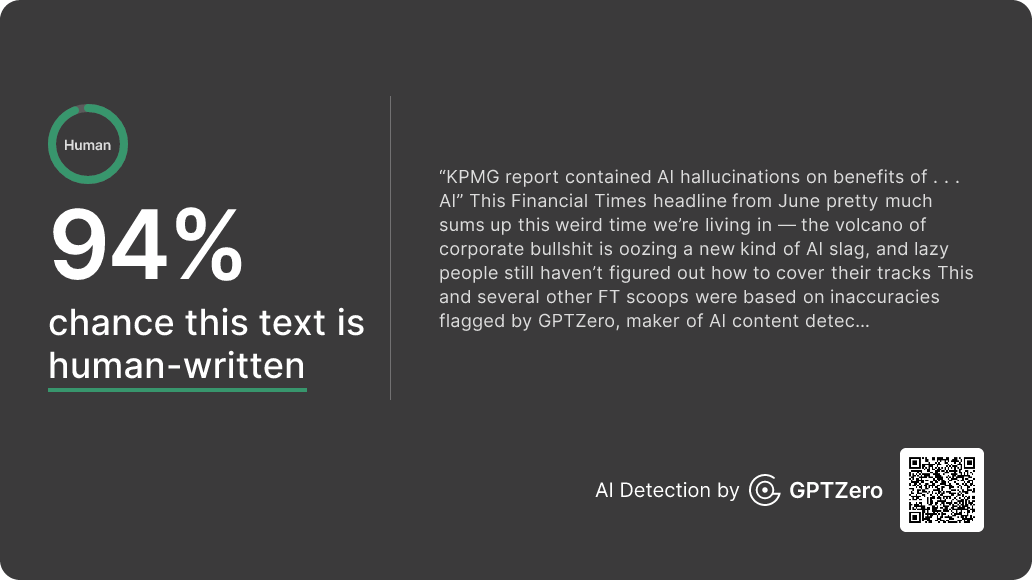
“KPMG report contained AI hallucinations on benefits of . . . AI”
This Financial Times headline from June sums up this weird time we’re living in — the volcano of corporate bullshit is oozing a new kind of AI slag, and lazy people still haven’t figured out how to cover their tracks.
This and several other FT scoops were based on inaccuracies flagged by AI detection platform GPTZero. Co-founder Edward Tian was a senior at Princeton University studying journalism and computer science when he built the first version of the company’s product. It was just weeks after ChatGPT had blown the world’s mind for the first time, and he foresaw the plagiarism these new tools would enable.
Three years and millions of users later, GPTZero was acquired by Superhuman (formerly Grammarly) in June, and Edward joined the Superhuman team.
In his first interview since the transition, Edward chatted to me about what he’s building after AI detection, the AI writing principles his team created for Superhuman, and why editing is such an important skill.
Our conversation is below, edited for clarity and brevity.


Tell me about your new role at Superhuman post-acquisition and what you’re building.
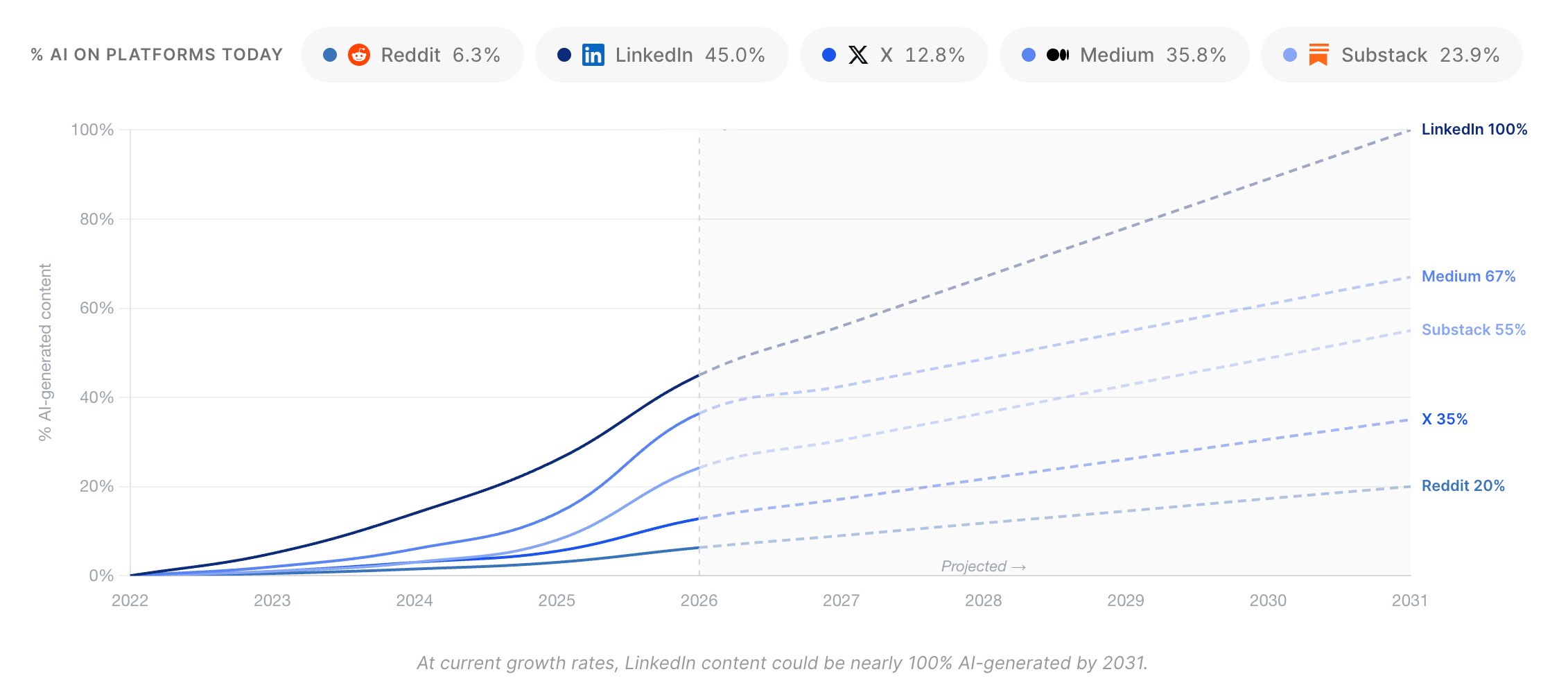
There are two things we’re already switching up. One is that we’re going to build beyond AI detection. We want to create the largest public database in the world for how AI is being used on the internet. We have a new site, istheinternetai.com, as a starting place for collecting what people are seeing. The same way that Wikipedia became a public source of information on the internet, can we be a resource journalists or everyday people can use to see how AI is showing up online? That’s our vision of an authenticity layer.
Two, we just launched an assignments product — creating assignments of the future, some with multiple steps to submit. We’re working with a professor in the UK, Dr Sam Illingworth, on one where he asks students to create their own writing that’s essentially AI-proof.
We want to build products in education, for the equilibrium that teachers and students are navigating around the right amount of AI use — products that preserve critical thinking and have those education insights feed into the larger Superhuman product, the assist layer that follows you everywhere as you work.
How are you approaching AI and writing within Superhuman?
One of the first things is that we’re drafting an AI use and writing policy for the company. A lot of people think we’re against AI usage, which isn’t the case. And with our AI detection and monitoring, people assume there’s a lot of “this opinion piece is AI” callout energy, which also isn’t really the case.
We’ve worked with journalists in the past: a New York Times journalist on AI-generated biographies flooding Amazon, and three pieces in the FT about hallucinations. The idea is that those were worth calling out because they damaged information, versus [calling out] an opinion piece that happens to be AI-written. Calling out mediocre writing is a different problem. The hallucination cases — the McKinsey-style reports, say — are actually wrong. They pollute the information ecosystem, because now people search for the same things and LLMs return rotten information.
So we’re not against AI writing use — quite the opposite. Now that we’ve joined this larger company, we believe they should use AI in their writing. They’re an AI company, after all. But there should be some principles: AI is the first draft, not the final one. Editing is thinking. Quality over quantity — the reader deserves more effort than the time it takes them to read something. And longer is not better.
The last principle is basically the inverse-pyramid style of communication, taken from journalism — prioritize and highlight the most important information, because AI tends to generate more and more, and the critical points get lost in the noise.
We drafted these four principles, and the CEO said, “Great, send them to us; I’ll add you to the monthly email that goes to the whole company.” It’s not massively shaking things up, but it’s part of joining a larger AI company that’s obviously going to use AI — the question is what’s the right way to do it.
Edward’s AI writing principles:
AI is the first draft, not the final one
Editing is thinking
Quality over quantity
Longer is not better
The distinction you’re drawing between calling out misinformation and calling out just bad writing is interesting. I’m more of an advocate for calling out writing when it’s bad, because that’s my specialism — I’m there to advocate for clear and eloquent communication.
To change the topic a bit, what do you see people in your peer group or younger struggling with when it comes to AI?
One thing we’ve realized is there’s definitely an overreliance on AI among people who finished university entirely after ChatGPT launched, compared to people before. I think that’s endemic in writing. If you take the tools away, there are more and more people who never really learned to write.
What we’ve realized is the actual skill worth preserving isn’t writing itself: it’s editing. That editing, revision, and thinking process — whether you’re editing your own first draft or the AI’s first draft — is what’s necessary for quality, and that’s what’s increasingly being lost.
My most impactful professor in college was John McPhee, a creative writing professor. I took his class in his last year teaching, when he was around 89 years old. I was the only computer science major in that class, so we talked a lot about technology and writing, and he was genuinely curious about whether AI could write in his style.
The big takeaway was that the core of the writing process is editing: a good editor changes everything. That’s tied to critical thinking: it’s never really about the first draft, even when you’re writing entirely on your own. One of his last books was called Draft No. 4 for exactly that reason. Now everyone thinks AI is going to generate the first draft, but what happens to the editing that gets you to the second, third, fourth draft?
As someone who was the lone computer science major in a writing class, how do you think we bridge that gap between tech and the humanities, especially with all the anxiety and mistrust around tech tools at the moment?
Just like when you first started writing your novel and went straight into Claude to see what was possible, it’s helpful to run these tools yourself and see what’s missing, because there’s always something missing. Whether it’s a year ago or now, these tools still aren’t fully producing great work, great summaries, great notes on their own — you still need good editorial and writing judgment. So maybe that’s the starting point.
Superhuman is trying to lean into being a writing-assistance company — Grammarly has always been the most popular assistive app for writing. You’re already doing the work. Can we assist you rather than do it for you? It’s philosophically quite different from doing the whole task for you or replacing your function.
It’s interesting to dig into Grammarly a bit — I’m a professional writer, but I’ve used Grammarly for years, and I’m not scared to say it’s great. But no one really thinks of it as an AI tool. They did such a good job of making it feel integrated and natural. How do you think they pulled that off?
I think their real sweet spot isn’t just the Silicon Valley early-adopter crowd — it’s outside that bubble too, people who’ve never really touched other AI tools. My dad uses Grammarly.
If a tool is good enough, it gets embedded in your workflow. You don’t have to consciously enable it or have someone tell you to go use it; it’s just organically there. There’s a lot of design work that goes into making a tool feel that natural.
I’ve been thinking about note-takers. A lot of these AI note-takers are evolving to be so naturally there that you stop thinking of them as AI replacing you. It’s less “bright billboard AI” — in your face — and more something that’s just there for you. That takes a lot of design and product thinking to get right. When you get there, it becomes more of an assist than a replacement.
Definitely. In keeping with that, I think that the way we interface with AI tools will change dramatically going forward and feel much more natural. My other question was — what did you get wrong early on about the impact of AI on writing or on work?
There were two camps early on. One thought that AI detection wouldn’t matter, because everyone would settle into using AI everywhere, all the time. That turned out not to be the case. I remember VC investors passing on us because they were so pro-AI that they assumed everyone would use it every day.
But it turns out that people want the truth. This is something we’ve thoroughly believed in as we’ve built out tools for monitoring AI on the internet.
The second thing is realizing it’s not binary. People used to think something was either entirely AI or entirely human, and more and more we’ve realized people are writing with AI and with themselves. Even our own classification system now has a mixed, third class, instead of the binary we always had before. I think most other AI detectors are still binary, but we added that class to represent the fact that this is changing, and people are writing with a combination of human and AI tools. That’s probably what most of the world will be doing in five to ten years, rather than everyone using AI or no one using it.
If you could go back to university now and start as a freshman again, would you study computer science, or would you pick something different?
I majored in computer science and minored in journalism. At this point, I’d probably flip it around. Everyone’s majoring in computer science now, and I wonder if the advantage is as large as it used to be — maybe it’s smaller than being a CS major pre-2020, pre-AI, because now you don’t need to be an extremely technical computer science or math major to work beyond just AI use. So I’d flip it — if I went back, I think I’d want to major in journalism and spend more time in the humanities, while still keeping that technical exposure.

If you’re London-based and want to talk to writers thinking about AI and creativity, join the next Founder-Writer Collective event with Alys Key on September 30. Or come be part of the audience of the live podcast I’m recording on AI, branding, and the “great flattening” on October 1.