



Want to set a writer off on a tirade? Ask them about the death of reading. We love to moan about how smartphones and social media have made it impossible for us to digest anything longer than a few lines. For some, this regression is the bellwether of a civilizational crisis.
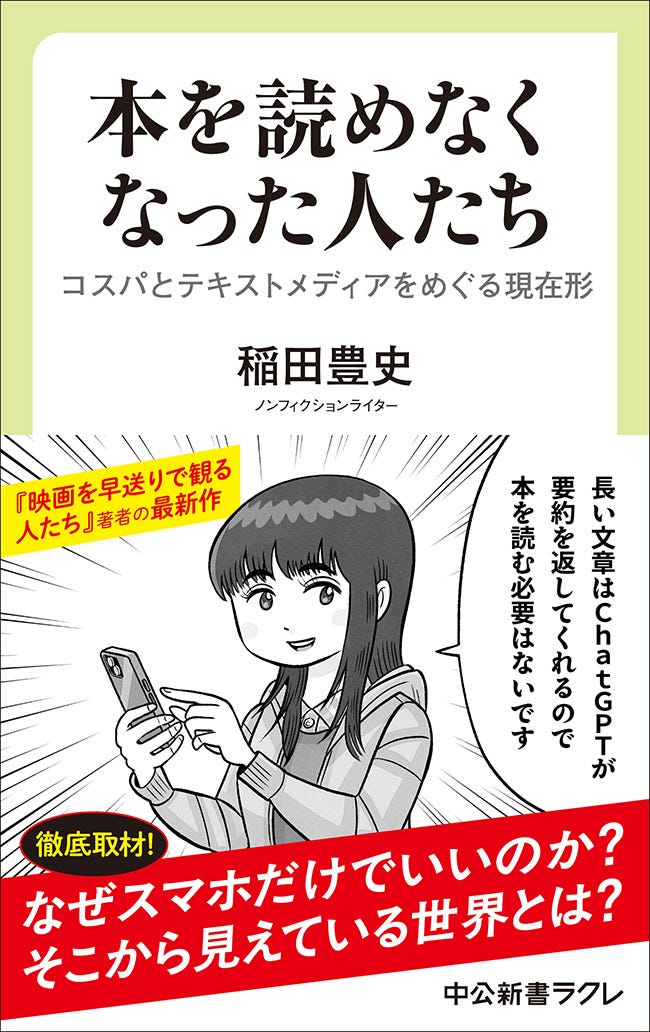
This is why I found non-fiction writer Inada Toyoshi’s latest book, The People Who Can No Longer Read (本を読めなくなった人たち), so refreshing. Inada has been a full-time author for over a decade — his livelihood depends on people paying him for his words — yet he approaches reading’s decline with curiosity and fairness, not dismissal.
The book is only available in Japanese for now, so I'm excited to introduce his thinking to a global audience. His conclusion: not reading is a rational adaptation to a world that prioritizes efficiency, where video is readily available, and text is expected to be free.

Some smart people don’t read books. We need to put aside our assumption that people who don’t read are not intellectually capable — reading might not fit their lifestyle or the way they like to consume information.
Reportage is an extremely valuable skill for writers in today’s age. How can you give readers information that’s not already on the internet somewhere?
Writers and books must evolve. The publishing and media industries need to provide formats that fit the lifestyles and preferences of a modern audience, instead of complaining that their audience isn’t consuming the same old thing.

What was the motivation for this book and for tackling this theme?
There were several reasons, but the biggest one was that, as someone who makes a living selling writing, I felt acutely that the economic value of writing was declining. The internet is fundamentally a place where people read for free, so the habit of paying for writing has disappeared. So in one sense, I was holding a magnifying glass over my own wound.
On top of that, there’s the long-discussed decline of the publishing industry and the global shift toward video over text for getting information. I wanted to bring all of that together, including my own experience, into one book.
The book is called The People Who Can No Longer Read. How would you define this population of people?
When someone watches a five-minute video instead of reading a two-thousand-word article, they’re not being lazy — they’re being rational. That’s the phenomenon I needed a word for, so I coined “hi-doku” (非読). Japanese already has a neutral term for “not reading” (不読), but “hi-doku” carries a judgment: that reading itself has become an irrational act, something that feels pointless. People may not articulate it that way, but society is gradually moving in that direction.
“When someone watches a five-minute video instead of reading a two-thousand-word article, they’re not being lazy — they’re being rational.”
This used to be a small group, but it’s been growing, starting with young people and spreading to working professionals. In response, the media is making more videos.
Within that shifting environment, people adapted — and in adapting, they lost the ability to read. They no longer needed to use that muscle. So “the people who can no longer read” includes people today who struggle with long texts, as well as middle-aged and older people who used to be able to read but gradually stopped as they consumed more internet content. It’s not that they lack the ability — they lost it as a consequence of fitting into society.
One of the things that sets the book apart is that you didn’t just rely on third-party surveys or data to assess this trend; you did group interviews with university students and young people. How did you conduct those?
It’s become a staple of my reportage writing. I start by approaching professors I know and asking them to introduce students.
I could have gone to a large lecture hall and asked for volunteers, but that’s not a good approach. The people who raise their hands tend to be the ones who are already engaged with media theory, so you get a skewed sample.
You might ask whether a written survey would be simpler, but this connects to the very theme of the book: most people can’t accurately express their ideas in writing. What they can do is talk. I press them — “What about this?” “Why do you think that?” — and draw things out through rapid back-and-forth. There’s information that only emerges through that kind of conversation.
As for why groups rather than one-on-one: some people simply won’t talk without others around. They get nervous alone, but when someone else in the group brings up a topic, it triggers something — “Oh, now that you mention it, I felt that way too.” Group discussion can surface things that don’t come out when someone is generating ideas solo.
One more crucial point: I never let the professor who introduced me sit in. If the professor is present, students worry about being evaluated and give model-student answers.
What did the group interviews show that didn’t show up in statistical data?
The biggest finding was that there are intellectually sharp kids who don’t read books. It’s a truth that readers are reluctant to accept — we assume that someone who doesn’t read can’t possibly be smart.
“We assume that someone who doesn’t read can’t possibly be smart.”
What I could only have learned through face-to-face interviews was that students with no reading habit were remarkably sharp in conversation. They gave answers that were right on target. Their communication skills were strong. Communication ability is arguably the most valued skill in business today, and I found it has very little to do with whether someone reads books.
There’s obviously a kind of intelligence you gain from books, but there’s also intelligence that comes from other sources. I wasn’t exactly devouring literary novels as a kid — I was consuming manga, anime, and games — and I developed a certain intelligence through those things that the older generation found hard to accept. But this has been said in every era. When cinema appeared, people probably said that watching movies makes you stupid.
As you said, the truth that people who don’t read can also be intellectual is a hard one for people to accept. But what about the actual quality of the content that is being read? Some people prefer novels, some prefer business books.
In the book, I distinguish between “readers” and “consumers.” Consumers are trying to extract information from books. They think in terms of cost-performance — I paid this much, so I should get this much information in return. Readers, on the other hand, find meaning in the act of reading itself. They read to keep their brain working.
It’s like weight training. What matters in training is the time you spend pushing your muscles. The longer you do it, the stronger you get.
To use food as an analogy, consumer-style reading is like eating carbohydrates — you eat it, and five minutes later, you can move. Reader-style reading is more like eating slow-absorbing food — meat, cheese, protein. You don’t get energy from it immediately. It takes time and effort — combined with something like exercise — to build your body. I’m not saying one is better than the other. But if you want reading that stays with you in the long run, you need the slow kind. Otherwise, it won’t truly nourish you.
How does the work of being a writer change in the context of a world where reading has become irrational for some people?
Writers are in a similar position to craftspeople who lost livelihoods during the Industrial Revolution. Some people appreciate the quality of what a craftsperson makes, but their numbers keep shrinking. More people don’t care whether something was written by AI or a human, and writing itself is losing value.
To survive, therefore, requires creating writing born of a powerful personal impulse — because I’m this particular person, I had no choice but to write it. Nobody will pay for something that’s merely well-written or well-organized.
We cannot change the fact that people don’t want to pay for text, so writers need to write something that can’t be read for free. Everything that generative AI can assemble from information across the internet is effectively free. Anything you can produce sitting at a desk is meaningless.
“Writers need to write something that can’t be read for free. Everything that generative AI can assemble from information across the internet is effectively free. Anything you can produce sitting at a desk is meaningless.”
What’s left is the kind of thing you get from group interviews — listening to real people in person. Information that doesn’t come up in a search. Everything a famous person has ever said is already on the internet, so celebrity quotes have no value — unless you’re asking them something they’ve never been asked before. But when, say, a grandmother in rural Aomori says something remarkable, I’m the only one who heard it. That’s where the value is.
So reporting skills become enormously important. This is good news for me as a journalist!
Exactly. Pounding the pavement and the ability to draw things out of people. Only writers with exceptional communication skills will survive.
In the old days, a writer could be an introvert and make it. But now you have to behave like an extrovert to survive as a writer. Show up in person, be charming, and engage with people on social media.
Speaking of social media, people in publishing and traditional media tend to look down on platforms like TikTok and X. But what you’re saying is the opposite: to succeed as a writer, you need to make content that’s at least as engaging as what’s on TikTok.
Whether the content on social media is trashy or sophisticated is a separate question. But the presentation techniques are something everyone should study. The editing is so well-crafted that viewers are never bored. In fact, TV editing is already converging toward YouTube and TikTok-style editing.
The same applies to writing. Old-guard writers look down on internet-style writing that puts conclusions up front. But a piece that meanders endlessly before getting to the point no longer fits the times. It’s like opera or old-style musicals that ran for five hours. That doesn’t match modern lifestyles. Even movies — sitting in the same seat for two or three hours is increasingly at odds with how people live, and yet the format hasn’t changed in decades.
There must be ways to preserve the density and depth of the content while changing the presentation. The physical format of books hasn’t changed either — the same size, the same 200 to 300 pages. But who says that’s right? Maybe a much larger format would be better, or maybe a much smaller one. Nobody decided how many characters should be on a page. The industry has gone decades without experimenting, and I think it’s been left behind.
I’m taking a fiction writing course, and we’re told that you have to hook the reader from page one. If someone picks up the book at a bookstore and looks at the first page, how can I make sure they walk out having bought it?
I was conscious of this with my book, too — the preface is about ten pages long, and I frontloaded all the most interesting material there. You can read just those few pages and get a sense of what the whole book is about.
The old approach to a preface was to tease — “Something interesting is about to begin!” But that’s not enough anymore. I’ve been doing this intentionally, and the result is that people read the opening and think “This looks interesting.” I think that makes for writing that fits the current era. Writers need to do this, and publishers need to as well.

Thank you so much for reading! I’ll be taking a break next week for Easter and will be back in early April. As always, any comments are appreciated.
Great one! I enjoyed the point that intellectual sharpness comes not only from reading but also from other sources—and how various forms of “reading,” such as manga or playing games, can develop other types of intelligence.
My conclusion: even though writers and books must evolve to provide formats suitable for modern audiences, we still need to return to traditional reading. It’s an activity we should commit to once in a while to balance out the quick dopamine hits that short-form content provides..
Just as building muscle helps prevent disease, we should engage in traditional reading to support our cognitive functions.
Thanks for posting the interview! I found it at parts interesting, depressing, and a good reminder I got to keep talking to people.
> Anything you can produce sitting at a desk is meaningless.
This is getting more true over time, but I think is overstated at the moment. To take an example from today: https://blog.andymasley.com/p/whats-blocking-waymo-in-dc-and-how
Andy Masley wrote a long blog post laying out the current state of play of Waymo approval in Washington DC. This could have been done by anyone at a desk, but I think is still valuable for someone to compile all of the information into one place. Maybe not *so* valuable that Masley could directly make a living from it, but a real public service at least.
More broadly, I think there are two reasons to read what someone wrote: 1. get answers to a question 2. to understand what questions to ask in the first place.
To get novel answers to 1, definitely need to talk to people and do real reportage. But I think there can still be an edge --- albeit a much more difficult one to obtain --- from desk writing if the questions asked are interesting and the work itself is high quality.