



The tech gender gap is already showing up in AI tools, which women are adopting at a 25% lower rate than men. Around me, I see women who are both intimidated by “technical” tools and unable to find the time to get started. Playing around with ChatGPT gets pushed down on the to-do list — then falls off entirely.
Nina Willdorf and Shoshana Berger want to turn that on its head. Nina is a former travel magazine editor turned brand strategist who has worked at Coinbase and Airbnb; Shoshana was also an editor who has had senior roles at IDEO and Notion. Their partnership started at a mutual friend’s birthday party, where they got chatting about AI and discovered they had the same boyfriend: Claude. (Who also happens to be my boyfriend, but I will not air my jealousy here.)
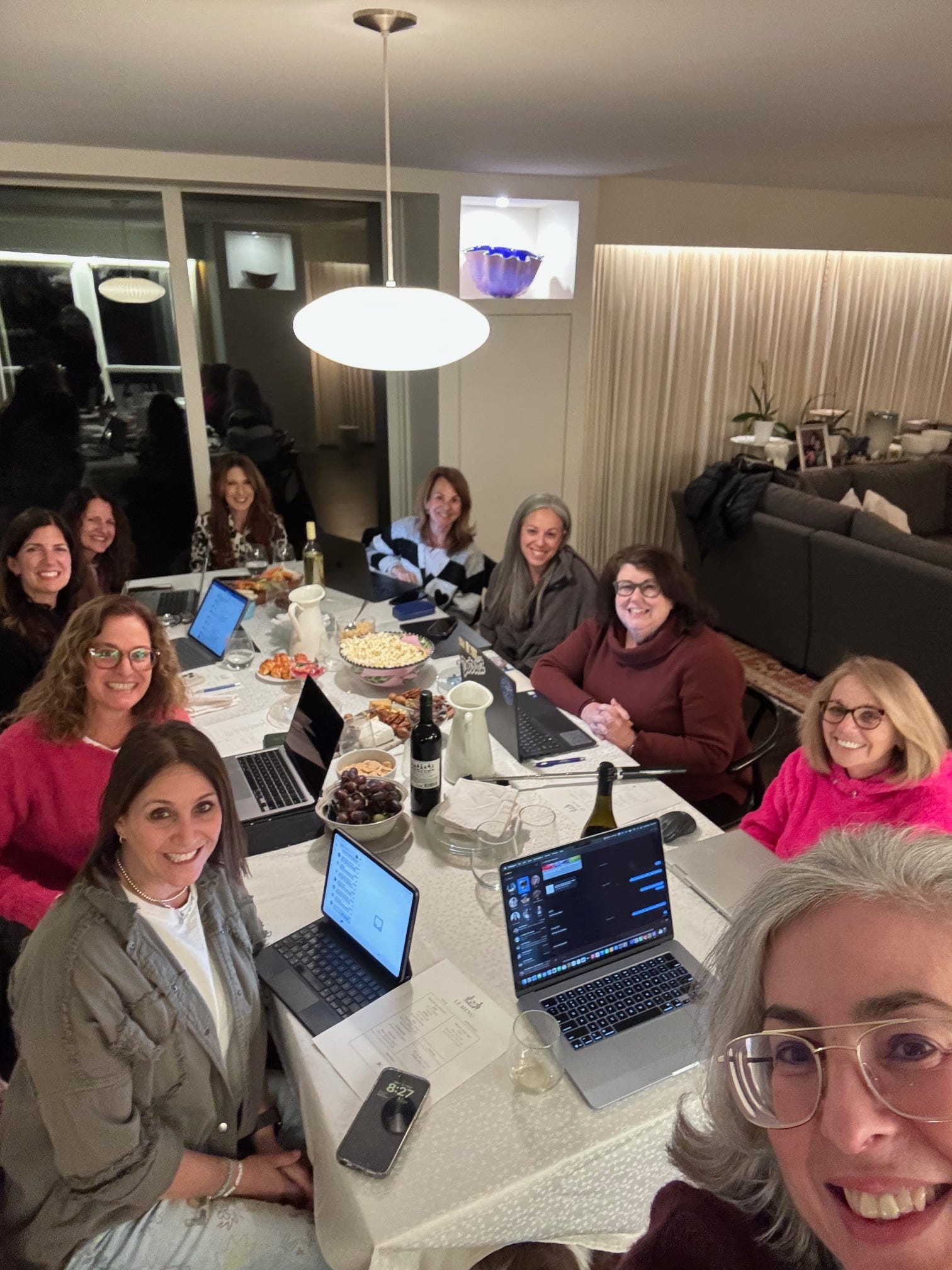
Now they’re using a classic gendered trope — the Tupperware party — to gather women 40-plus around wine and cheese and get them playing with AI. They call it the Aged Intelligence Society.
We chatted about why women should be natural AI power users, what happens when you show someone AI in person for the first time, and what kind of writing actually matters right now.

Use AI to deal with the annoying life admin. Do the things you like in life — writing, painting, coaching — and let AI deal with the admin.
Don’t prompt, volley. The biggest mistake people make is treating AI like a search engine: one shot, one answer. You have to have a back and forth.
Embrace the wabi sabi. AI gives everyone access to the same polished language. What breaks through now is beautiful roughness, writing that shows lived perspective, and a point of view only you can have.
Our conversation, edited for clarity and brevity, below.



What is the Aged Intelligence Society?
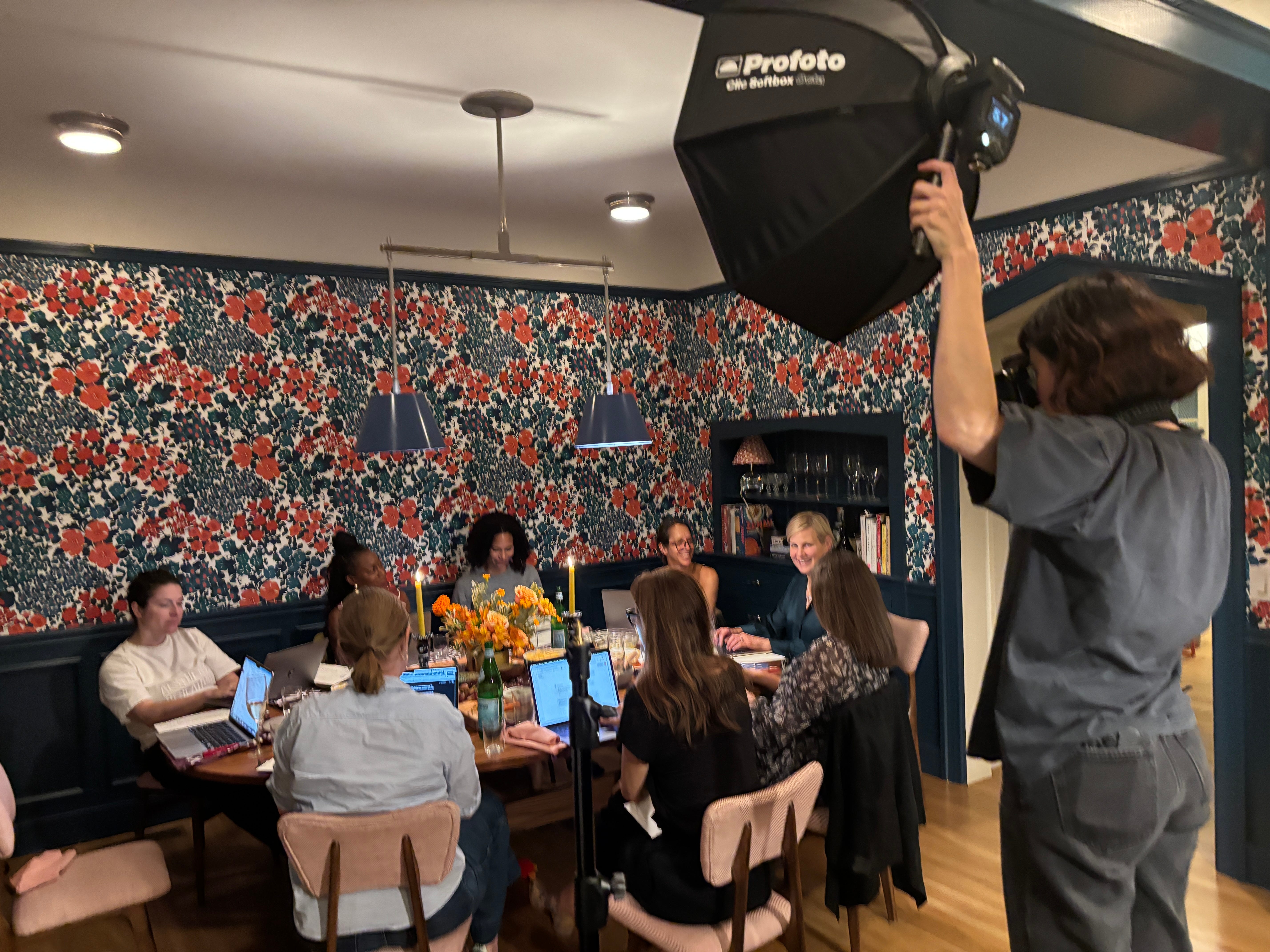
Nina: We were both obsessed with AI, so we decided to gather some women and do some events around a dinner table. It took us about three events to figure out what the arc would be.
One, how do we create a feeling of “I’m with my people” with people you don’t know? So we really curate who’s at the table. In many ways, it’s an editorial exercise — what are the characters that make for a good story?
And then, what are the beats of an evening? How do we leave people walking away with a feeling, as well as inspiration and information? There’s usually someone who comes in as a skeptic: “I love to write, and I don’t want AI to write my emails.” Then by the end, they’re like, “It can do that? I had no idea.” That little spark in the eye — it’s incredibly gratifying.
Shoshana: I would describe it as two women who have long been in tech circles and understand what it looks like when women are excluded from the conversation.
Midlife is a tricky time to navigate. Women are dealing with relationship changes, career pivots; they still have dependent kids and are also starting to care for increasingly fragile parents or relatives. There’s a big administrative load. We want women to understand that you can put down some of that load if you use these tools.
I don’t think people understand that part of AI. The conversation has been around productivity and optimization — how can we do more, how can we replace basic skills? But it’s the opposite. It’s about how we do more in less time so that we have time to do the things we love, rise to a higher altitude, and do purpose-driven work.
We are taking a tool that is known to be a solitary, one-to-one interaction and making it a group activity — something we can all have conversations about, laugh about, kick the tires on, and think about how, as women, we can shape its use.
Nina: There was a big unlock we had: especially as women 40-plus, 45-plus, who wear so many hats — it’s exhausting. You’re the CEO of your life, but also the CIO, the CMO, the CRO. How many of those do you want to be, and what would you like to outsource?
That is a choice we get to make now that we didn’t have a few years ago. You can confidently outsource certain things. So if you’re a writer, write. Do your craft. And outsource the invoicing, the scheduling, all the other things to AI. We don’t see AI as replacing the magic skills we’ve built. It’s creating more space for that.
So in contrast to the fear and FOMO-driven narrative around AI, you’re telling a very different story — one at the micro level, about what’s really useful for women, every day.
Nina: The thing we’re constantly thinking about is: where does the magic of the human blend with and add to the magic of the machine? We have so many years of experience living in the world, and we bring that to the machine.
For example, we were brainstorming about a trip Shoshana is taking with her daughter. I’m a former travel magazine editor, so I thought about the places in New York that are my absolute favorites for sample sale shopping. This is something you cannot find online.
She took that into Notion AI, and it turned it into a detailed itinerary and walking tour that also flagged when some of the places would be closed. It took it one level further, but the inputs would not have been there without the human.
Shoshana: Exactly. The food recommendations came from a friend who’s a food writer. And then I had the AI look up the best times to go.
What about in your professional lives — how has AI shown up there?
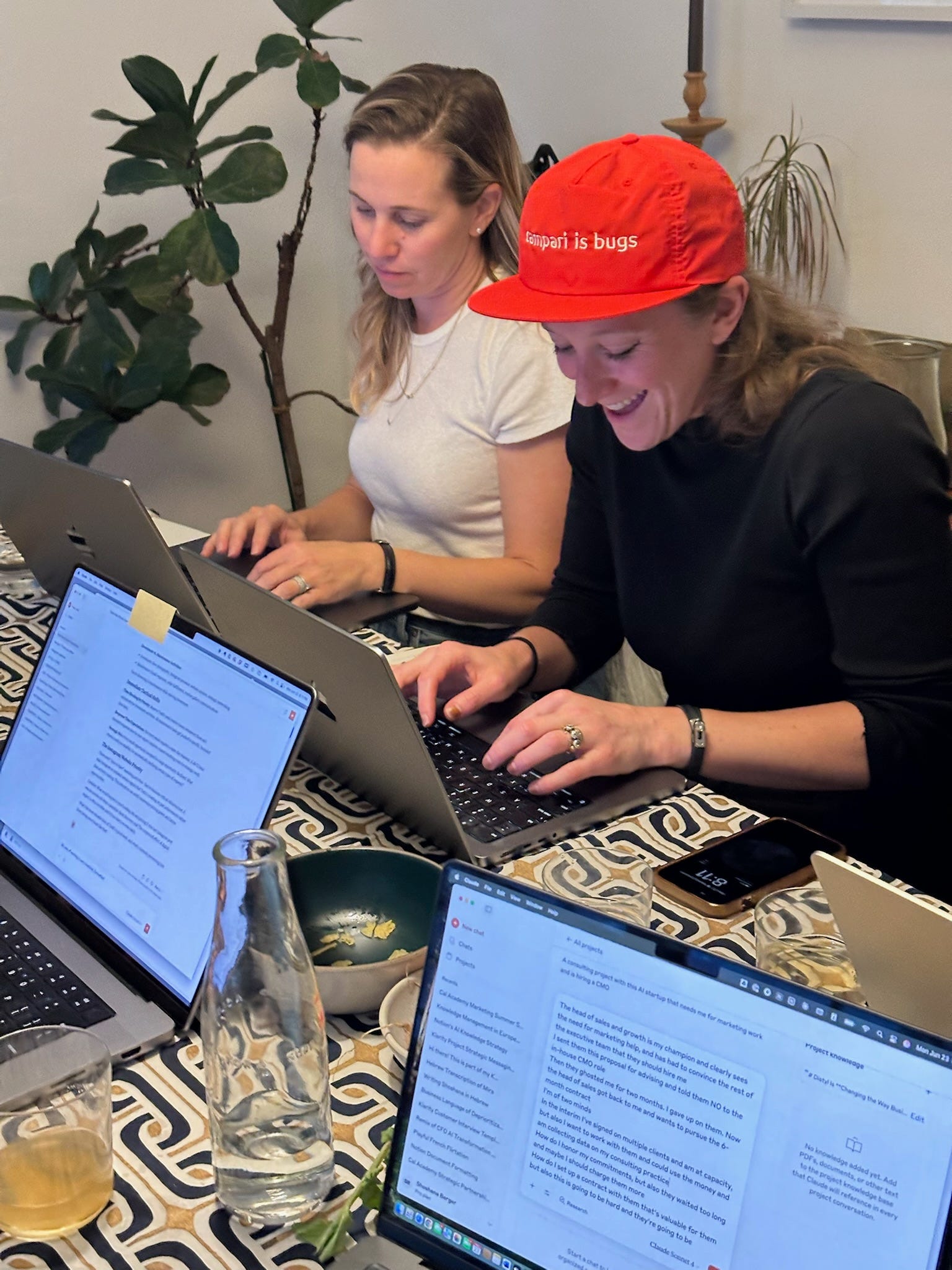
Shoshana: When I was starting out as a consultant, Nina kindly shared a lot of her paperwork with me — how she deals with proposals and all of that. I used ChatGPT to create proposals and tiers of engagement for my initial clients. I had a “70% there” proposal done. I fed it into Claude and said, “Make this an easy yes.” Claude came back and said, “You’re not charging enough money.”
I was like, “Wait—I’m not charging enough?” Classic female problem, right? I asked, “How should I adjust this?” And it said, “Start by doubling your rates.” I took the advice and sent it to the client. They did not bat an eye.
"I said, 'Make this an easy yes.' Claude came back and said, 'You're not charging enough money…Start by doubling your rates.' I took the advice. The client did not bat an eye."
What’s that lightbulb moment for women who come to your gatherings?
Nina: We have a moment we call “library time,” where we give people 10 minutes alone to mess around after we’ve given some general guidance. We prance around the table and help people.
Usually, they’ll type a prompt and be disappointed. For example, one person was dealing with a friend who had gotten very politicized. Her other friends had abandoned this friend, but she didn’t want to, and she was trying to figure out how to navigate the relationship. After getting feedback from Claude that was very surface-level, she said, “See, it doesn’t work.”
I asked her why the feedback didn’t feel right, and typed everything she said into Claude. You have to tell it, “This isn’t resonating for me. I know all of this already.” Talk to it like you would talk to a person — except you don’t need to worry about its feelings.
What we do is demonstrate what Shoshana originally called a “volley.” It’s a tennis match, not a one-shot thing.
That reminds me of learning in business school that women are actually better negotiators because of how we’re socialized to look for outcomes that benefit all stakeholders — the same back-and-forth, dialoguing skills apply here.
Nina: And there's a through-line to voice here. In those moments at the table, the women are saying things out loud to me, and I'm typing exactly what they say into the context window. Your natural voice — the way you talk — is going to get you the best results. You don't need to write the perfect prompt.
Shoshana: I’ve learned so much from Nina’s chatting style, because she really does chat with her AIs like she’s chatting with a friend, where you pull no punches. She’s like, “No, you got this totally wrong. What’s wrong with you?”
Nina: I act like I’m from 1940s Brooklyn.
You both have children — how do you see AI impacting them?
Shoshana: We have a lot of the same reservations that other people have about how kids are adopting the tool. I had a conversation last night with my kids about the best way to learn something: read a book or use AI.
My kids open up AI and say, “Tell me everything about the American Revolution for my test tomorrow.” They get a response in two minutes, and think, “If I had to read the whole book, it would take me days, if not weeks.”
I told them that there is something about the interaction of reading words on a page and appreciating the way an author has put the story together, the discursive way in which the information is revealed to you, that is rich and dimensional in a way that AI will never be. If you don’t read books and take in the stories that way, you will have a very flat and shallow appreciation of things.
They heard me, but I had to lay it on thick. They don’t necessarily want to be history majors, so they think, “Why wouldn’t I just use this shortcut?”
I told them, “If you ever want to get a job, you must be able to write and tell stories and communicate.” Scott Galloway says this all the time. You have to be able to show up without the AI in life. That takes work, and you learn how to do it by reading and practicing.
Nina: We hear from women in our community that some teenagers actually don’t like AI. My younger one, for example, is anti.
But I like to show them different things. For example, with college applications, my daughter and I were brainstorming in the car, and she was coming up with super disjointed ideas for what she might write about. I said, “Take all of those notes, dump them into Claude, and say, ‘What are some potential angles I could take? What questions could you ask me to tease out some of these ideas?’”
She did all the writing and used the AI as a thought partner — almost taking the place of those editors we had growing up who pushed us as thinkers.
Let’s come to words and effective stories. There are so many stories being blasted at us right now. How do you tell an effective story? Can you break through?
Nina: Our instinct comes back to detective work — figuring out what is fundamentally human and resonant, and what gets people to feel something. That is the job of a writer, an editor, a marketer, a communicator. You have to get underneath people’s motivations and understand how you can connect them with what they’re trying to achieve.
It’s awesome that everybody has access to knowledge and information, but it’s creating a flattening. People are getting increasingly annoyed by it.
We don’t write our newsletter using AI. We sit side by side with espresso and our laptops. Shoshana is better at writing at night, I’m better in the morning, and we pass things back and forth.
One of the things Shoshana unlocked yesterday that I think is so apt is this notion of wabi sabi — this beautiful roughness. Right now, in writing and communicating, what you want to show is that you’ve thought about it. Writing is just an embodiment of thinking. When people get annoyed with AI writing, they’re saying: “Don’t be lazy. Put some thought into it, because otherwise you’re wasting my time.” If you don’t demonstrate that you’ve thought about it, it’s an insult.
Shoshana, what would you add?
Shoshana: You know that phrase, “You can’t write this shit”? It’s true. You cannot write this shit — what it feels like to be a human in the world. It is wonky and rough-edged and full of broken things that none of us know how to deal with. AI does not have that experience, no matter how many times it reads the internet and no matter how much we feed it. It does not have embodied experience. And that’s where the most delightful stories come from.
“You cannot write this shit — what it feels like to be a human in the world. It is wonky and rough-edged and full of broken things that none of us know how to deal with."
There is something about lived experience that is very hard for AI to approximate. Especially for people who have been working at the craft of writing for a long time, you understand that it’s all about that frictive point of view. It’s not linear. It’s surprising. It works on pattern recognition, but unlike AI, it’s the pattern recognition of someone’s subjective point of view. Nobody sees like you see.
Nina: You know how everyone and their mother wants to be a thought leader? In order to be a thought leader, you have to have a thought. And the uncomfortable truth is that 99% of people do not.
“In order to be a thought leader, you have to have a thought. And the uncomfortable truth is that 99% of people do not.”
Words indicate a perspective. The perspective that gives you a feeling. Sometimes it makes you uncomfortable, sometimes it gives you pause, sometimes it just makes your brain click on in a different, interesting way. That is what writing can do.
I think we’re all getting annoyed because there’s so much out there that doesn’t make you feel anything. So the value of real writing is just going to increase. English majors, unite.

If you want to learn more about Nina and Shoshana’s work, check out their newsletter.
Have you ever vibe coded with wine? How have you taught someone else about AI? Reply and tell me about it.
Oh, what a brilliant idea -- wine, cheese, befriending AI, and befriending other women who befriend AI? This might be the most delightful thing I've read on Substack in a long time! I need to try this at home.
This made me giggle: “You know how everyone and their mother wants to be a thought leader? In order to be a thought leader, you have to have a thought. And the uncomfortable truth is that 99% of people do not”