



Everyone is squeezing in the last summer holiday, myself included. I’ll be at a Jackson Hole, WY wedding — dress code “black tie Western.” If anyone has tips for how to satisfy this requirement without looking like a clown, please reply to this email.
With my mind full of travel, it’s fitting that this week’s guest should be on a long journey of his own. Nishad Sanzagiri was a consultant in London until he landed a book deal. For most, that means a long date with a desk. For Nishad, it meant moving back to his home country of India a year ago to write a literary travelogue. He’s been on the road since.
A few things resonated for me in our conversation:
First, I’m a lot like Nishad: if I have an idea for an article or a post in my head, I can’t write anything else until I’ve cleared that idea. I’ve accepted that I need to lean into it in order to move to the next thing.
Second, I found myself nodding when Nishad talked about some of his more personal newsletter writing resonating more than others. This is the advice I give every founder: don’t shy away from the personal and the emotion. You’re writing for humans, after all.
I hope Nishad’s story and his gorgeous photos inspire you to take that once-in-a-lifetime trip.

What’s your relationship with writing? Did you like to write as a child?
It still feels weird calling myself a writer, but I always did write. It comes with being an only child as well. I used to journal quite a lot and write down everything from small anecdotes about my day to big things that happened, and in high school in Oman, I started a school newspaper. But more than anything, I was a reader.
It’s so interesting that you said it feels weird calling yourself a writer. So many people say this, even those who make their living from writing.
I never felt there was anything wrong with saying, “I was a consultant,” or “I worked in comms.” But there is huge baggage that comes with that word, “writer.” I have gotten better at it, but even now, when someone asks, “Are you a writer?” I almost feel like I’m overstating something, or that I should be more humble about it.
What do you tell people that you’re doing now when you’re traveling?
I tell them that I’m writing a book, or I over-explain and say, “I’m on a sabbatical, and I’m writing this specific book.” I worry that anytime anyone assumes that you’re a writer, they think that is the only thing you do. I don’t want to be boxed in as, “Oh, this is it, now all I’m going to do is write books.” Obviously I’d love to write books, but I also did enjoy my consulting years and journalism.
Those are all professions with a real respect for finding the right words. What did they teach you that you still use? What did they teach you about your own voice?
When it comes to my own writing, I don’t mind the fluff, and a lot of the time it’s a sort of stream of consciousness coming out. Whereas in corporate language, or in journalism, one of the best skills is getting to the crux of things and explaining something in the fewest words.
In my last job in strategic communications, I worked a lot in the narrative development space with CEOs, heads of corporate affairs, or heads of comms. Before writing a CEO speech, for example, you work out what their voice is and what it is that they want to get across. That helped me hone the skill of finding the right choice of words, and at the same time it made me realize that I wanted an avenue to develop my own voice. I kept thinking, “If I had to say the same message as the CEO, how would I explain it?” And that’s sort of how I started my Substack while I was working.
Why did you name your newsletter Infinity Inklings?
I’ve moved, I’ve changed careers quite often, and I’ve dabbled in different things. I came across the phrase “expert generalist,” and it caught my eye. It’s almost like this whole jack-of-all-trades, master-of-none sort of concept.
My initial thought with my Substack was a place to be able to write everything and anything, almost like a public journal. That’s where the whole infinity side came in.
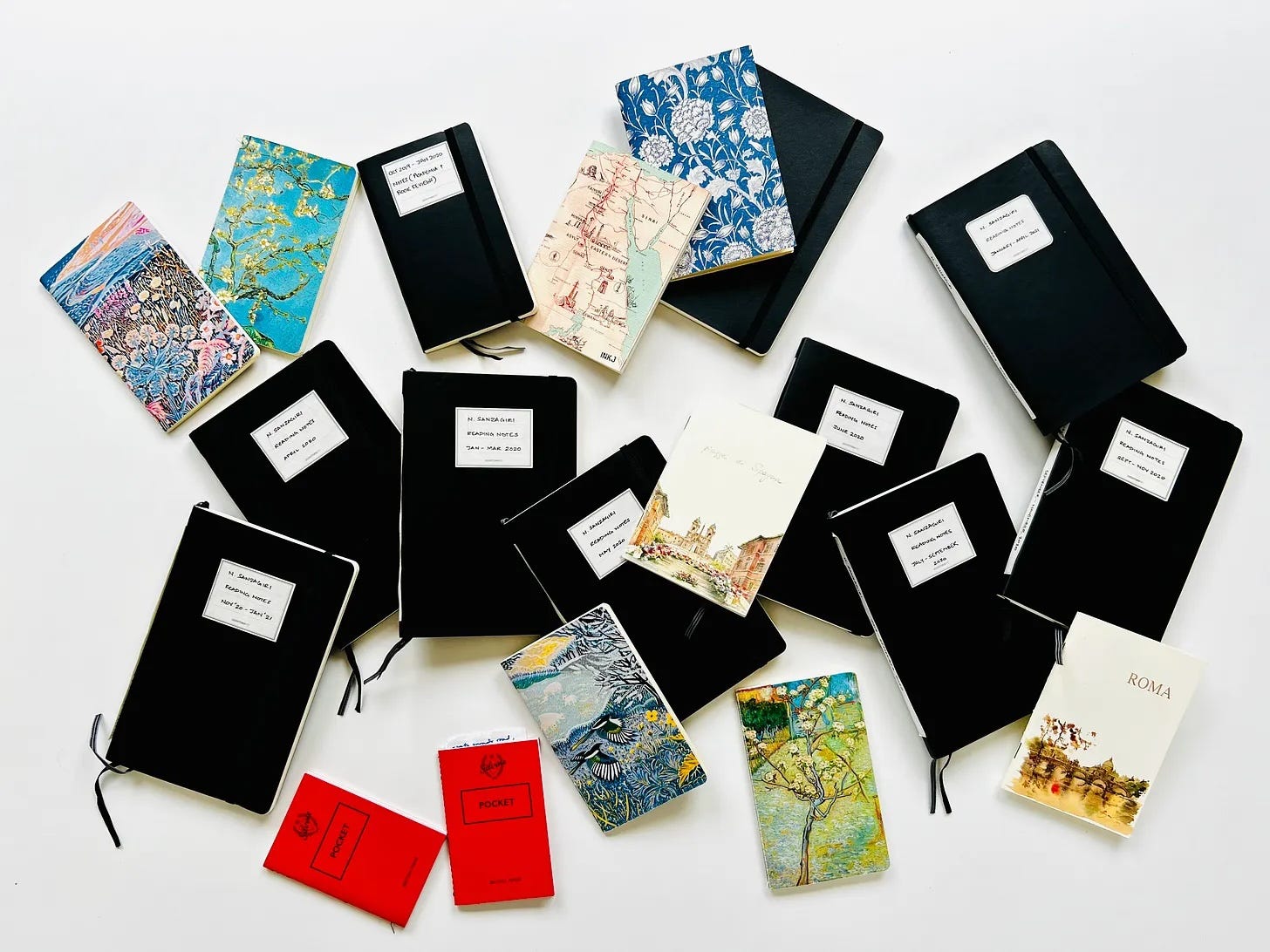
The inklings referred to little tidbits. When I started the newsletter, I had a habit, and I still do to an extent, of always keeping a little pocket notebook with me. Whenever I thought of anything or came across any news, I would jot it down. I would even cut things out of magazines or newspapers that I found and stick them in there. That would then be the inspiration for whatever I was writing that week.
Did you always buy the same little notebook?
I went through phases. Initially I had those tiny Moleskines and Leuchtturms. Then there was another one which was lined on one side and plain on the other. That was quite good when I wanted to draw or paint.
Let’s talk about the book.
The book is narrative nonfiction about the religious diversity across India. It will cover India’s sacred geography — everything from Hinduism to Buddhism, Sikhism, Islam, Judaism, and Christianity. It’s part travelogue of my visits across the length and breadth of the country, part collection of interesting stories from these places. The places I’ve chosen are not that well known, even for people in India.
At a point in time when religious fundamentalism is on the rise, and there is such calcification of identity, I wanted to show how much diversity is out there. That is our inheritance.
I’m hoping most people will read it end to end. But because it’s a collection of short stories, you don’t need to. You can dip in and out of specific chapters, a decision my publisher and I took given dwindling attention spans.
How has it been to write on the road?
Initially, there were certain parts of the journey where I was writing a lot — I could do a whole series of pieces about Ladakh or Kashmir or something like that. Then there was a stretch where even writing for the book felt tedious, let alone Substack.
I remember reading your piece about writer’s block.
I’ve learned to embrace the inspiration when it strikes. I’ve also noticed that I’m good at writing when I’m on the move — in a train carriage, or when I’m sitting in a bus, or stuck in traffic. It’s about making sure I can capture it when something comes — either by taking a voice note or scribbling my thoughts down in a notebook.
Is there anything else that you’ve learned about how to get yourself in the mood to write or your creative process?
For a while I felt frustrated because there have been a lot of times when I’ve churned out a random newsletter piece or op-ed when I should have been writing a chapter of the book.
I tried to deal with it by thinking, “Okay, even if I thought of an idea for an article, I’m not going to write it.” But then I realized that I could not move on, that the idea kept festering there. So I was like, “No, if it’s come to me, let it come. I’ll do the chapter later.”
What has going back to India shown you about yourself?
Travel brings out so many different emotions and feelings. It holds a mirror to you. And especially for someone like me, who always identified as Indian, was born in India, spent my first seven years there, but who has lived outside of the country for most of my life — first in the Middle East, then here in the UK — going back was quite an interesting return.
There are so many preconceptions that you have when you’re traveling across India. Sometimes you fall into the trap of “I want the more authentic experience,” the trap of defining authenticity as something cheap and devoid of luxuries.
I realized I didn’t need to do that. When we talk about India’s diversity, it’s not just in languages and customs and religions. You also have amazing cafés with faster internet than in London. I’m a sucker for coffee, and I realized that it’s okay to go to a place that is gentrified and sit there and write. I came to terms with the fact that I was not doing a disservice to my country by paying the equivalent of three pounds for a coffee.
A part of me has always felt most at home at a cute café, no matter where I travel. When I’m in India, I sit at an independent café, and the words just flow. I can focus on a chapter and drink black coffee. It feels like I could be anywhere in the world in one of those cafés. It’s almost like the most clinical setting that you can get.
When I was in Panama earlier this year, I had a full day of writing, and I did exactly that. I found a third-wave café — with delicious Panamanian coffee — and sat and wrote. I crushed the final chapter of my book. Changing the topic, do you use AI in your writing?
Not substantially in the writing itself, but quite a lot in my research. So much of my work is also going to new places, so sometimes I’ll ask AI to create a primer with sources and citations that helps me prepare. I have used it in transcribing interviews and even my own thoughts. Sometimes I’ll use it for line editing — “I’m stuck at this sentence; is there another way of explaining this better?”
For some of the op-eds that I’ve written where I’ve had to edit down a longer piece I’ve written, I’ll say, “I need this to be 900 words; what can I delete out, and what is the overall skeleton structure that would make the most sense for a reader?” That sometimes has been quite useful.
Personally, I do think more people should use it as long as they use it wisely and cross-check their work.
And what has writing brought you? What has it given to you — both the Substack and maybe the work on the book?
It’s helped me slow down. It’s taught me a lot about myself. It’s therapy — even writing an op-ed.
I published a piece about The Odyssey, asking who decided the gods are white. I linked it with India, where most of the gods worshipped by people who are overwhelmingly brown are still fair. Where does that come from? This came from a debate I had with a friend, and so writing about it later was my way of trying to get closure on that discussion. That’s what I mean when I say sometimes even a nonfiction piece feels like therapy in that sense.
Has anything surprised you with what has resonated with your readers?
The emotional ones. There was one where I talked about how grateful I am to my parents and how much I love them. We take physical journeys, and we take emotional ones. And sometimes the stories of the emotional journeys are the ones that resonate most.
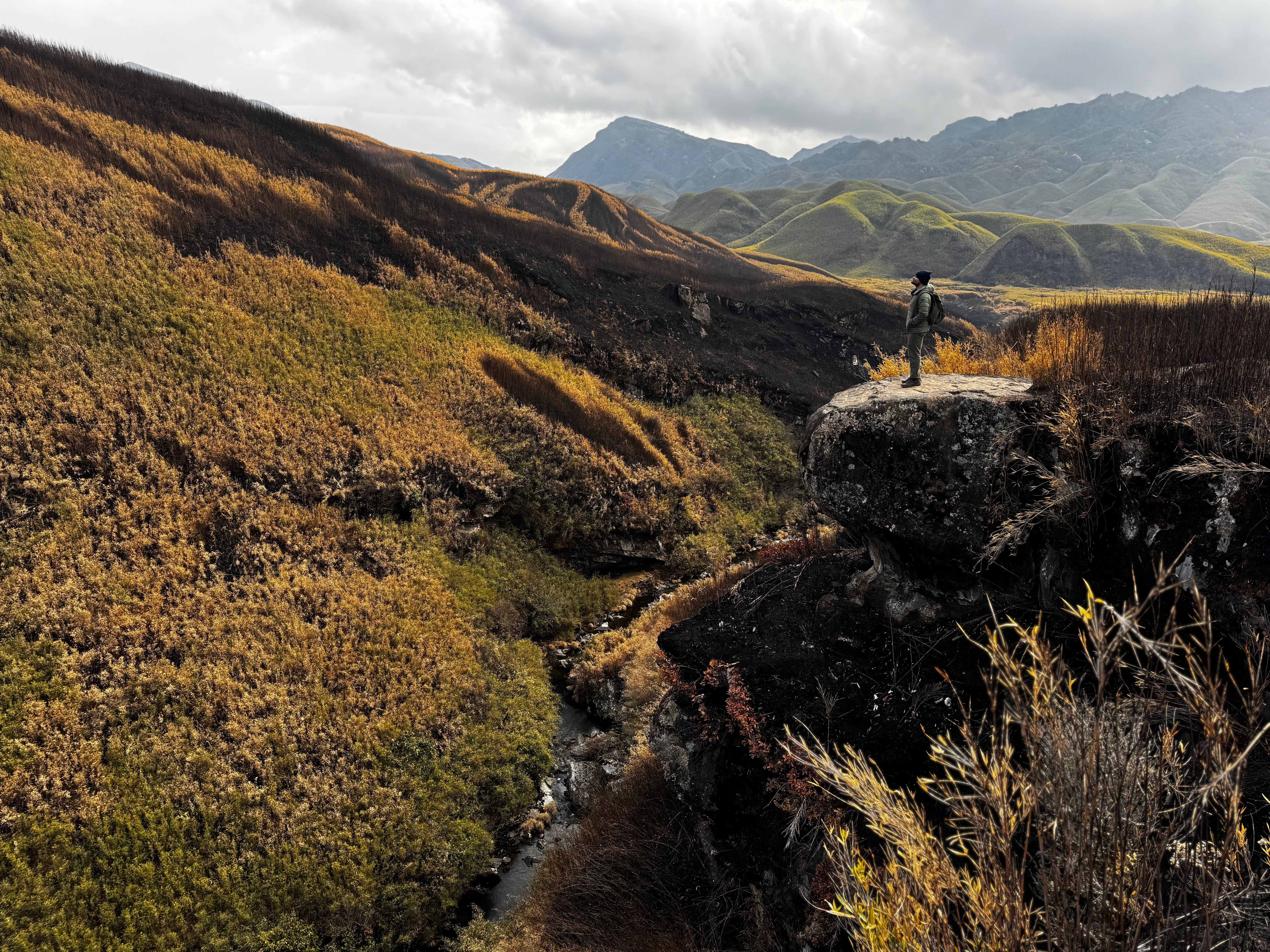

Some of my favorite travel writing, Nishad included:
As a bit of a drifter myself, I keep coming back to Nishad’s piece about having a lifetime of “situationships with cities.”
L'Usage du monde (The Way of the World) by Nicolas Bouvier recounts the Swiss writer’s early 1950s trip in a Fiat 500 Topolino from Europe to Afghanistan: “We denied ourselves every luxury except one: that of being slow.”
The Shadow of the Sun collects Polish journalist Ryszard Kapuściński's dispatches as Poland's lone correspondent in Africa, from the 1950s onward: violence, kindness, heat, the highs and the lows. Though his legacy has been questioned, you can’t deny the prose is gripping.
See you all next week with more stories.
this was an inspirational piece as it makes me want to get out more in the world, in particular to India