



It feels right that Eight Words or Fewer, a book about micropitches, undercuts its own rule in the title…by half.
The slender thesis is the baby of Emma Ketterer and her husband, Adam, B2B tech branding and positioning specialists who argue that the difference between a brand and its rivals should be distillable into a tight, memorable tagline. At a moment when people are using AI to produce so much content that CEOs are begging their staff to be concise, it’s a refreshing take.
Emma cut her teeth at legendary B2B agency Velocity Partners, before stints leading content for pharma clients at an agency and in-house at Philips. She’s now global lead editor at Celonis, one of Europe’s most valuable private companies. She kindly agreed to chat about what she thinks B2B brands are doing wrong, her favorite taglines, and why AI writing still falls short.

B2B brands should be less worried about being boring and more worried about grabbing audience attention. That’s why you need to be able to distill yourself into a micropitch.
Ketterer’s Law states that copy will spill into whatever word count you set. Commit yourself to concision.
The fear that “everything’s been said” is wrong. Strong opinions are getting rarer, and an original take is more valuable now, not less. So write that LinkedIn post or that book you’ve been meaning to!


What’s the core problem that you were seeking to address with this book?
A lot of B2B companies do a good job of figuring out what they stand for and how they’re different from competitors. They have good answers to the big questions: What problem do we solve, what are we enabling for our customers, what does the future look like? Then they capture that in long form, whether that’s through positioning docs, slide decks or whatever — but when it comes to distilling all of that down to one, memorable message, these positioning exercises fall short.
In a lot of places I’ve worked, we get 99% of the way there. Adam had the same experience, so that’s how the book came about.
If you look at how B2B business communications has changed, why do you think that distillation has become a problem now?
I think there was a time when the challenge in B2B was to not sound boring. You’d try to stand out by having an exciting voice or even sounding like a B2C brand.
But being able to stand out now is so difficult because everyone’s saturated with messages all day, every day. You’d be lucky to even have the opportunity to bore your audience. If you’ve bored a reader, then you’ve done a great job — they’ve stuck with you long enough to be tired of your content. 99% of brands don’t have that opportunity. Someone’s scrolling past you, and you’ve got one second to wow them. So boredom is so far down on the list of problems.
You need distillation because you’ve got a few seconds to make that first impression, and that’s only going to get harder over time.
“If you’ve bored a reader, then you’ve done a great job — they’ve stuck with you long enough to be tired of your content. 99% of brands don’t have that opportunity.”
You’ve made me think that we’re in an era of maximizing things. Looksmaxxing or Londonmaxxing, using AI to create a whole document instead of three bullet points. So running the other way and saying, “How can I shape this down into the single most compelling thing” becomes a differentiator.
Exactly.
What do a lot of B2B tech brands get wrong about their positioning and the way they talk?
There’s a tendency to become too introspective. A lot of material might work well within the team that created it, but sometimes that work gets lost when you have to communicate it across a business and have everybody else communicate it well in the right places, on the right channels, for the right audiences.
Tech is complicated. It’s easy to create messaging that everyone internally — people who are hands-on with the product — can grasp. Things that might seem commonsensical or intuitive to you may not be to a cold audience.
That connecting thread between the foundational work and making sure it’s being executed in the real world — I think that’s sometimes also what’s missing.
Who do you think does this distilling really well?
I’m a big fan of Entrepreneur First and their tagline: “Found, don’t follow.” It says, “If you want to found a company, create the dream team, move fast, get to Silicon Valley, then these are the guys for you.” You don’t want to move slowly. You don’t want to go the traditional route.

I’m also a Stripe fangirl. I go to their marketing and try to steal whatever inspiration I can because they always nail it. Their mission statement, “Increasing the GDP of the Internet,” is such a fun, creative line. You have to unpack it for a second to understand it, but it’s such a compelling line that you make that effort to understand.
Speaking of Stripe, the founder of Every, the company I work for, interviewed someone from Stripe on our podcast, and one of the first things he said was to reference that tagline. That’s the ultimate comms success — when the people interviewing you parrot back the line.
That’s the goal. When you have that micro pitch, if you nail it, it’s what people repeat. When someone asks, “Hey, what does X company do?” they default to your line.
Does it have to be eight words? Is this a challenge or a hard and fast rule?
If you set it as a soft limit, things tend to expand. There’s a famous observation called Parkinson’s Law: Work expands so as to fill the time available for its completion. We’ve created an equivalent we’re calling Ketterer’s Law: Copy will spill into whatever word count you set as a limit.
With eight words or fewer, you’ve got enough room to get in the key ingredients. But there’s zero chance of being waffly at that length.
There have been some interesting studies on how many words people can remember when they see them for the first time. Eight words or fewer seems to be this magic sweet spot.
Do you use AI in your work at all? If so, how?
I use it for research a lot. Sometimes, if I’m going to interview somebody, I ask it to give me a download on the person. Sometimes I chuck a bunch of notes and ask it to summarize them.
For actual writing, I’ve tried — I really have. What I find AI really misses comes down to conviction. It doesn’t do a great job of having a unique perspective that it seems to feel strongly about. It might be authoritative in the tone it’s written in, but I don’t feel like this person really believes what they’re saying. I do when a human writes something. As much as I’ve tried to get it to ghostwrite for me, it doesn’t quite nail it. It doesn’t feel like an argument I would actually make.
Outside of writing specifically, I’m experimenting with a few things. One is refining and accelerating the early stages of the positioning process — that point where you’ve gathered input from a wide range of parties in a wide range of formats, and want to condense that down into consolidated notes, see where the synchronicity — or discord — occurs, and whether a pattern is emerging that can be mapped to whatever framework you’re working with. I’m also experimenting with using AI for content strategy and review — looking at things like persona fit, regional fit, industry fit, and so on.
“What I find AI really misses comes down to conviction. It doesn’t do a great job of having a unique perspective that it seems to feel strongly about. It might be authoritative in the tone it’s written in, but I don’t feel like this person really believes what they’re saying.”
How do you see the shortcomings of AI?
I read an article in State of Brand about the “great flattening” of writing. It’s so true. LLMs are giving everybody the statistical average of everything that’s been written. They’re making everybody sound like everybody else. You get this dulling of tone.
AI is so new, relatively speaking, and the fact that we’re already recognizing this gives me a bit of hope. People already see the shortcomings. I can only hope that people who actually write for a living and love it and want to protect it will defend that for as long as possible.
If you really strongly believe in something, then the writing part is kind of half done because you already know how you feel. You already know what you want to say. You already know what your point of view is, and how strongly you feel about it, and that comes out in how you write it. You can’t be dull if you believe in something strongly. AI doesn’t literally have feelings yet.
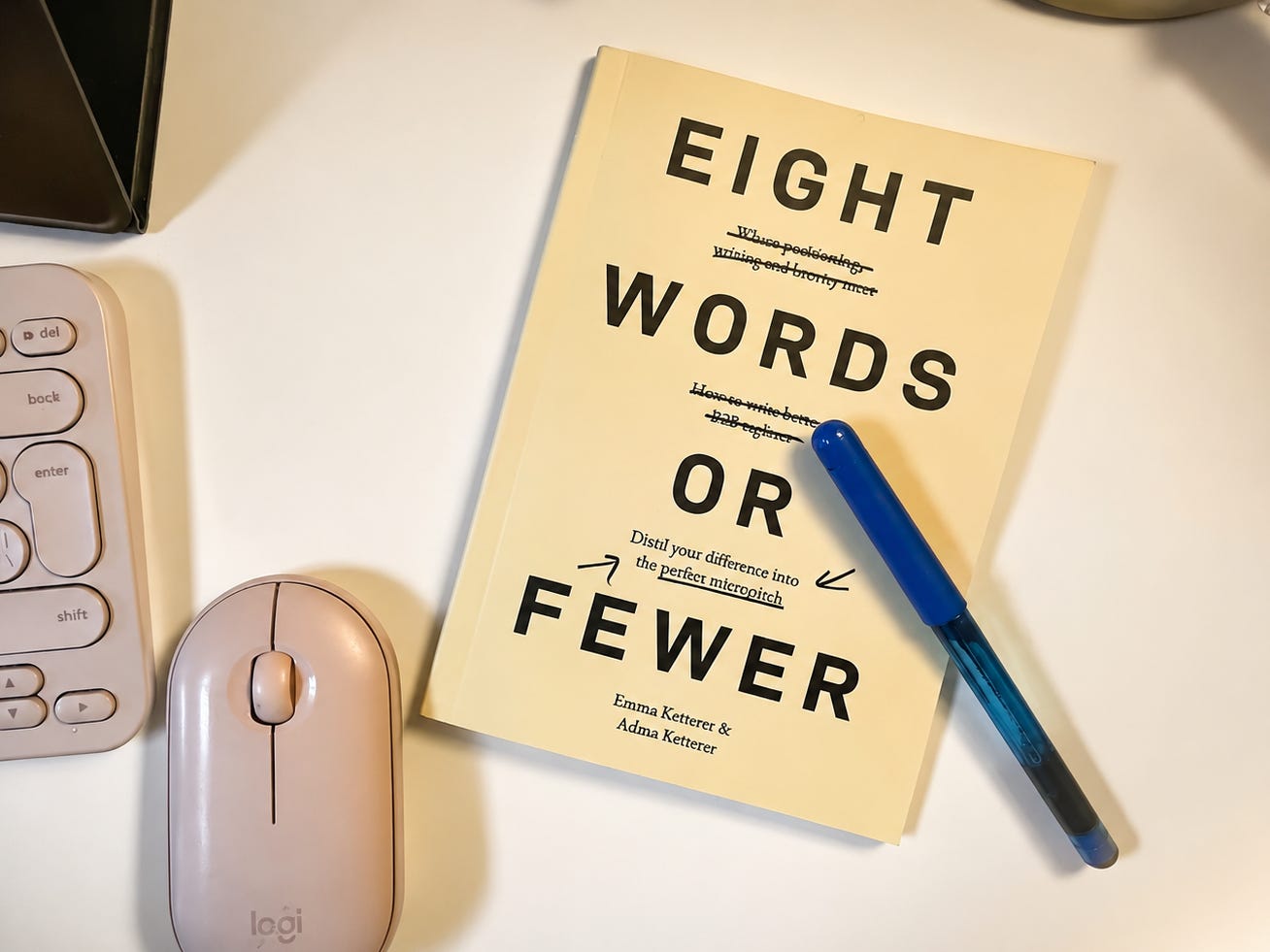
I loved getting the book in the mail. I read it in bed, highlighted stuff. It seems like the kind of thing I can keep on my desk and go back to and be inspired by. Why did you decide to do it as a book versus a series of LinkedIn posts, a video, or something else?
When we started writing it, we weren’t sure what it was going to become. It just turned out to be the length it is. We considered doing a long-page scroll, but it’s nice to have something physical in your hands.
Print to me is still really precious. There’s so much being said about B2B marketing online, so it’s nice to break away and have a physical format. We saw it as almost a pocket or field guide. Something you can always come back to, highlight, annotate.
Tell me about the process of writing the book.
We have two little kids, so we put them to bed, then depending on how much energy the two of us have, we hash out these things in conversation. One of us writes something, then the next day the other one comes back to it, reads what the other person wrote, and tweaks it.
Every sentence in that book has been written by both of us, so we’ve had to find a tone of voice that represents us both. End to end was probably about six months of doing that — revisiting, rethinking, trying to get something we both love and feel is coming from us, but is also this middle ground between our two tones of voice.
It’s like you have a couple’s style guide. That’s the most romantic thing ever.
Or cringiest! I’m not sure which.
What’s been the response to the book?
The feedback has been really positive, and it’s encouraged us to try and write more things down.
It’s intimidating sometimes when you’re scrolling a social media feed or looking at blogs. You go on LinkedIn, and a million people are talking about AI and marketing. You think, “Everything’s been said already. How can I have a unique take on this?” But you can. It’s surprising how many organic ideas you really can have.
With this flattening, real strong opinions are becoming rarer. The idea we wrote about is something that doesn’t seem to have been covered before. We’re already talking about what we might write next.

Here are a few things I highlighted in Emma and Adam’s book:
“Good writing is good manners and good business.”
“If you can only be clear or clever, be clear.”
“Never use a verbose Latinate term when a lean Germanic word will do nicely.”
Thank you for reading! If you haven’t yet joined me, subscribe below.
My favorite line: "AI writing doesn't have conviction." So true. @Eleanor!