



Recently, I was summoned to a Mayfair pub to receive a special delivery. When I arrived, my friend extracted a large zip-lock bag from his backpack. Inside was a slim, green volume — one of only a few in the world, he told me, hence the makeshift stain-resistant packaging. The cover was embossed with three mysterious letters: “DTV.”
I was holding in my hands an account of the life of the late Sequoia Capital founder, Donald “Don” Thomas Valentine, and the firm’s beginnings, written by former Sequoia partner (and ex-journalist) Sir Michael Moritz after DTV’s death in 2019. Sequoia’s track record includes companies like Apple, Cisco, Google, and Instagram.

I’m obsessed with how businesses create their own mythology, and this short book — less than 100 pages — is one of the most interesting examples I’ve seen. Moritz and the firm put immense care into the story, which traces the parallel fates of Valentine, Sequoia, and the US tech industry, and the physical product. The spine is cloth-bound; the paper is hefty. My bookmaker friend estimates that printing 100 copies of these bad boys could cost as much as $3400.
Unlike many of the clamorous myth-making activities from Silicon Valley tech investors and companies — magazine shoots, manifestos, and elaborately produced podcasts — DTV was never meant for wide distribution. The scarcity of the book adds to the Sequoia legend, and it’s what gives it authenticity. Reading it, you feel like you're watching Moritz process his own grief, using his skill as a writer to build his mentor a lasting memorial in ink. It was not the first time that Moritz has penned a piece of Silicon Valley lore, either; when he was a reporter at Time Magazine in the early 1980s, he wrote the definitive account of Apple’s early days with Steve Jobs’s blessing.
The writing in DTV is efficient but warm. Moritz talks about being interviewed by Valentine, a meeting that included a tea ceremony and an original Apple pen. He reveals that Sequoia green is not just a nod to the color of the tree’s leaves. It was also the shade of pen that Valentine loved to write memos on, his favorite form of communication. He never signed his name to them, which caused some unfortunate confusion when people not in the know threw them out…
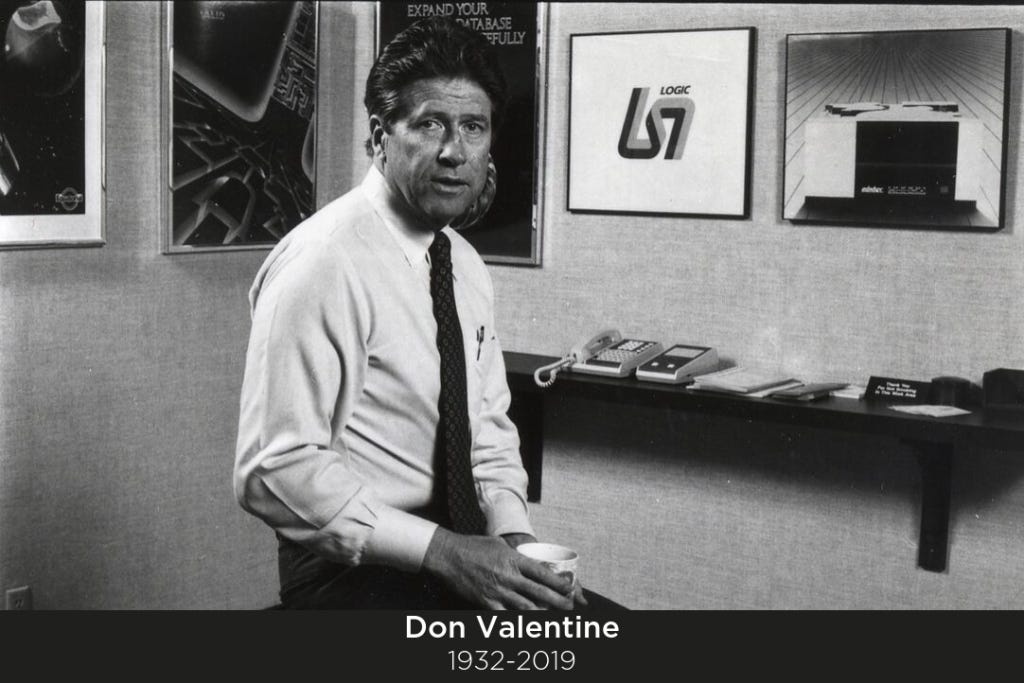
While the book paints Valentine as a brilliant company-picker, it doesn’t suggest he was a particularly easy person — a more honest depiction than most Silicon Valley eulogies might allow. Moritz describes him as someone who “took satisfaction in not being considered part of a group,” and a lifelong pessimist who was “not prone to imagine what might be possible if everything went right.” He could also be a tough customer to his founders, in some cases telling them he wanted his money back.
There are interesting details about Sequoia’s early investments, but not enough to interest the casual reader. This is something for the industry fanatics like me. What we can all take from this small book’s existence, however, is hope for the future for printed media. Even an industry as obsessed with disruption and speed as venture capital still turns to the old, physical medium of the book to cement legacy.
I wonder what Valentine would have thought of the tech industry’s current excesses — of founders taking tens of millions off the table before an exit, kombucha on tap in the office. What founders would he think worthy of a biography? And who would be worthy of writing them?

I said the book was a scarce commodity, but the internet has done its job, and a scan is available on Slideshare. Supposedly you can even get your hands on a physical copy if you visit Mike Moritz’s hotel in Tuscany…
If you’re interested in reading more of Michael Moritz’s writing, he published a memoir earlier this year about how his Jewish parents escaped from Nazi Germany.
Speaking of company lore, check out “Billion Dollar PDFs”, a compilation of memos, white papers, essays, or presentations that “introduced a new mental model, and changed how billions of dollars of capital flowed.” Sequoia’s “RIP Good Times” deck, written to guide portfolio companies during the 2008 crisis, made the list. It’s a classic I come back to every few years.
Have a good weekend. Read something hearty.
"The writing in DTV is efficient but warm." that's the goal isn't it
It’s good to read personal reflections of people who’ve managed to achieve remarkable success. The interesting thing to interpret is the extent to which they are simply trying to put the record straight, or just trying to tell it as it was, versus trying to reinvent the story to show themselves in an optimal light.